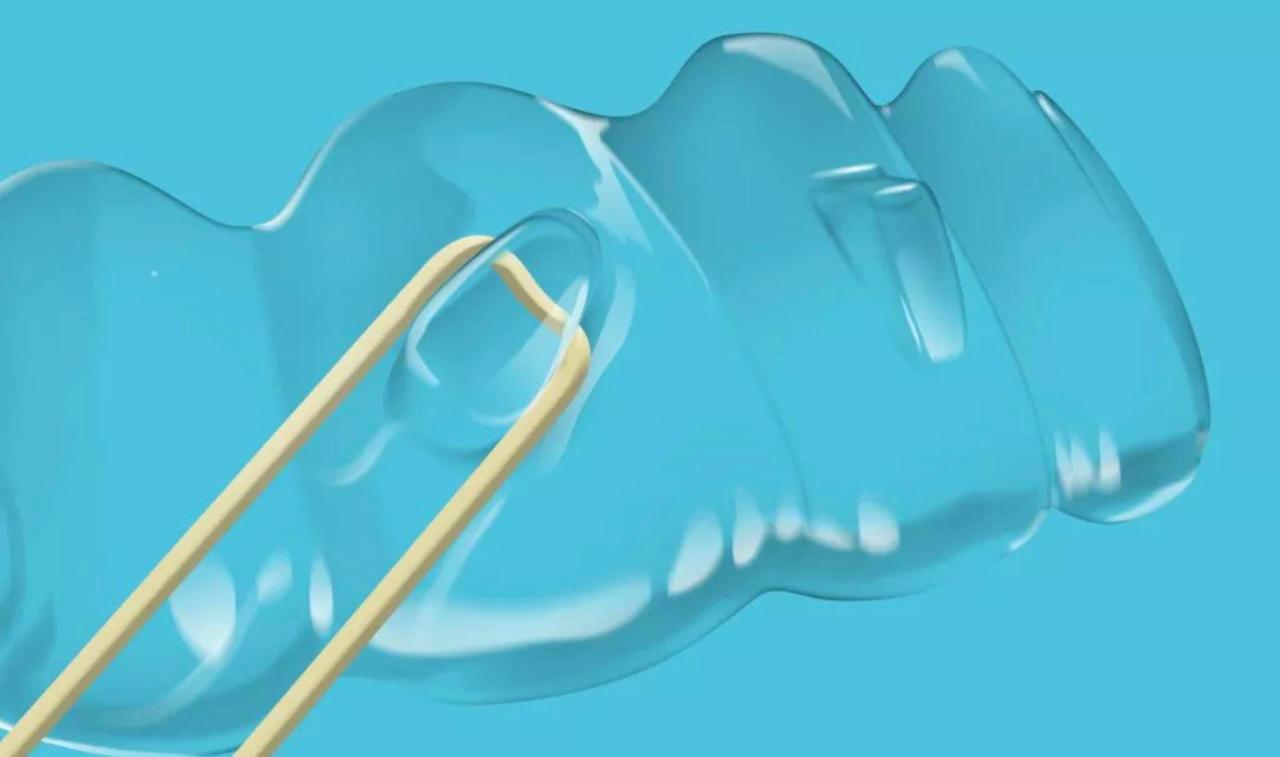
What causes swollen gums and gingivitis? In most cases, plaque (a film of bacteria) and tartar building up along the gum line make the gums red, swollen and prone to bleeding when you brush. Early gingivitis can return to normal once you clean better and have your teeth scaled by a dentist. Left untreated, it can progress to periodontitis, which destroys the bone around the teeth and can make them loose. See a dentist if a swelling has pus, the pain is severe, you have a fever, or the gum around a wisdom tooth is swollen.
Reviewed by the Smile & Co. Dental Clinic dental team
Updated November 2026
What Is Gingivitis, and How Is It Different from Periodontitis?
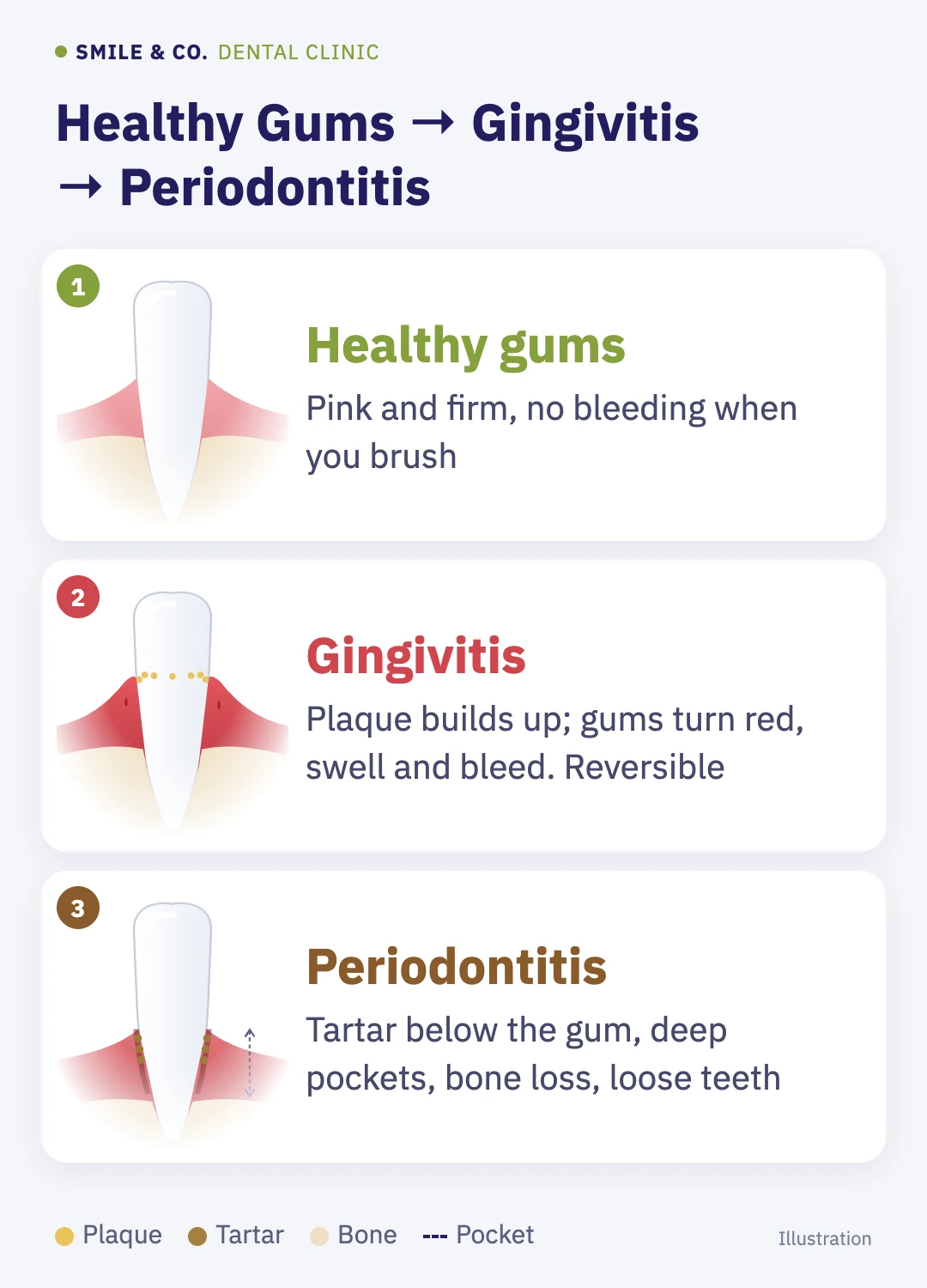
Healthy gums are usually pink, firm and do not bleed when you brush. Gingivitis is inflammation limited to the gums, and it can return to normal when plaque is removed well. Periodontitis is a more advanced stage, with loss of the tissue and bone that hold the tooth, which cannot be fully restored (Chapple et al. 2018)[1].
Gum inflammation is very common. Thailand’s 8th National Oral Health Survey (2017) found that about 88% of adults aged 35–44 had bleeding gums and about 26% had periodontal pockets (Srinarupat et al. 2021)[2].
What Causes Swollen Gums?
The main cause is plaque that builds up on the teeth along the gum line. A classic study found that when volunteers with healthy gums stopped cleaning their teeth, gingivitis developed within about 1–3 weeks, and the gums improved once normal cleaning resumed (Theilade et al. 1966)[3]. Plaque left for a long time hardens into tartar, which a toothbrush cannot remove.
Factors that make gingivitis more likely or more severe (Murakami et al. 2018)[4]:
- Smoking: raises the risk of gum disease and can hide bleeding, so the gums may look healthier than they are
- Diabetes or high blood sugar
- Hormonal changes, for example during pregnancy (Figuero et al. 2013)[5]
- Some groups of medicines, such as certain anti-seizure, blood-pressure and immune-suppressing medicines, can cause gum overgrowth. Do not stop a medicine yourself; talk to your doctor and dentist
- Braces or fillings and crowns with poorly fitting edges, where plaque collects easily
- Wisdom teeth that have only partly come through, which trap food
- Dry mouth and, rarely, severe vitamin C deficiency
Types of Gum Swelling
Red, Swollen Gums That Bleed When Brushing
The most common sign of gingivitis. The gums turn from pink to dark red, the edges swell and feel tender, and they bleed when you brush or floss. Some people also notice bad breath.
A Lump or Soft Swelling on the Gum
A lump can have several causes, such as a gum abscess (infection in a gum pocket or from a tooth root, usually painful and sometimes with pus), gum overgrowth from irritation (for example from tartar or during pregnancy), or a pus bump from a tooth with a dead nerve. A small, painless lump that shrinks once cleaning improves is usually ordinary gum inflammation, but have a dentist check any lump that grows quickly, hurts, has pus or does not go down within 2 weeks.
Swollen Gums with Pus
Usually a sign of infection, such as a periodontal or tooth-root abscess. Pressing may release pus or leave a salty or unpleasant taste, and there may be throbbing pain. See a dentist; do not try to drain or squeeze it yourself.
Toothache with Swollen Gums
If one tooth hurts a lot, hurts at night, or there is a bump on the gum near the root tip, the nerve may be inflamed or infected. This often needs root canal treatment rather than gum care alone.
Swollen Gum Around a Wisdom Tooth
The gum over a partly erupted wisdom tooth can become inflamed, swollen and painful, making it hard to open your mouth. A dentist will clean the area and assess whether the tooth should be removed (Schmidt et al. 2021)[6].
When to See a Dentist Promptly
- Swollen gums with pus, or a painful swelling (abscess)
- Swelling with fever, facial swelling, or difficulty opening your mouth or swallowing
- A swollen, painful gum around a wisdom tooth
- A lump in the mouth that grows quickly
- An ulcer or a red/white patch in the mouth that has not healed within 2 weeks
- Bleeding that continues after 2 weeks of good cleaning, or loose teeth
If swelling spreads to the face or you have difficulty breathing or swallowing, go to a hospital immediately.
How to Care for Gingivitis at Home
Early gingivitis improves with daily plaque removal (Chapple et al. 2015)[7].
- Brush twice a day with fluoride toothpaste and a soft brush, gently along the gum line. Keep brushing even if the gums bleed
- Clean between your teeth every day with interdental brushes or floss (Worthington et al. 2019)[8]
- An electric toothbrush reduces gingivitis slightly more than a manual brush (Yaacob et al. 2014)[9]
- A mouthwash can help as an extra step if your dentist recommends one, but it does not replace brushing
- For pain or swelling, use a cold compress on the outside of the cheek and a pain reliever as advised by your dentist or pharmacist
- Do not take antibiotics on your own; ordinary gingivitis is treated by removing plaque, not with medicines
- Stop smoking and cut down on sugar. If your mouth is often dry, talk to your dentist, as dry mouth can make plaque build up more easily
How long does gingivitis take to heal? With good daily cleaning, bleeding and swelling usually start to improve within a few days and are usually clearly better within about 1–2 weeks[3]. If bleeding continues after 2 weeks of good cleaning, see a dentist, as there may be tartar or periodontitis that needs treatment.
How Dentists Treat Gum Disease
- Examination: the dentist checks the gums, measures pocket depths and takes X-rays if needed to tell gingivitis from periodontitis
- Scaling with cleaning instructions: removes tartar and plaque you cannot remove yourself. Professional cleaning reduces gum inflammation (Chapple et al. 2015)[7], but routine scaling on its own, without better cleaning at home, makes little difference to gingivitis (Lamont et al. 2018)[10], so daily brushing and cleaning between the teeth are still needed
- GBT / air polishing: cleaning with air, water and fine powder. In studies of maintenance care after gum disease treatment, it worked about as well as conventional scaling and many patients found it more comfortable, so it is an option if you feel anxious about cleanings (Martins et al. 2022)[11]
- Root planing: for periodontitis with deep pockets, cleaning the root surfaces below the gum
- Gum surgery (open flap and root planing): for periodontitis with deep pockets remaining after root planing, the dentist may open the gum to clean the root surfaces thoroughly (Sanz et al. 2020)[12]. Available at our clinic; please ask for the price
- Treating specific causes: such as root canal treatment, wisdom tooth removal, or replacing fillings with poor edges
Prices at Smile & Co. Dental Clinic
| Treatment | Price (THB) |
|---|---|
| Scaling | 1,000–1,800 |
| Scaling + Airflow | 1,800 |
| GBT (Piezon) | 2,500 |
| GBT (Airflow) | 3,000 |
| Root planing | 500–800 per tooth, or 1,500–2,000 per quarter of the mouth |
| Gum surgery (open flap and root planing) | Please ask the clinic |
Instrument sterilization fee: 50 THB per visit. See all prices on our price list.
Is Gum Disease Linked to Diabetes and Heart Disease?
Severe periodontitis has a two-way relationship with diabetes. In people with diabetes, gum treatment slightly improved long-term blood sugar over 3–4 months (Sanz et al. 2018)[13]. Periodontitis is also associated with cardiovascular disease, but research has not shown that gum disease causes heart disease (Sanz et al. 2020)[14]. People with diabetes should have their gums checked regularly.
How to Prevent Swollen, Inflamed Gums
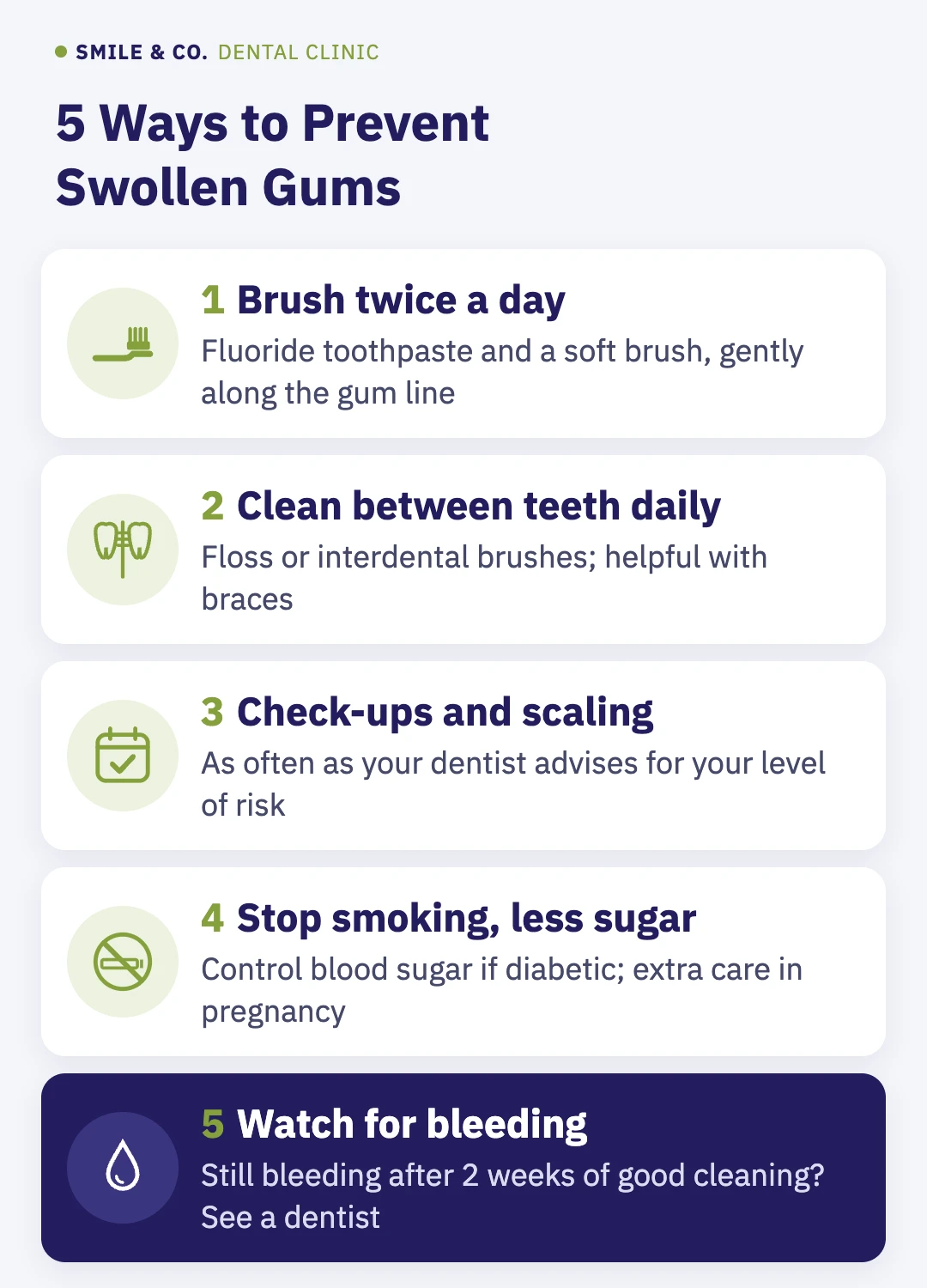
- Brush twice a day with fluoride toothpaste and clean between your teeth every day
- If you have braces or a bridge, use interdental brushes or floss threaders
- Have check-ups and scaling as often as your dentist advises for your level of risk
- Stop smoking, and keep blood sugar under control if you have diabetes
- During pregnancy, take extra care with cleaning and tell your dentist you are pregnant
- Watch for bleeding, swelling or bad breath and act early
Gum Care at Smile & Co. Dental Clinic
- Our dentists examine your gums and recommend treatment for your stage of disease, including Dr. Marinee Tossamasvorakul, our gum disease dentist
- Scaling, scaling + Airflow and GBT available, with prices explained before treatment
- An international-standard sterilization system
- About 2 minutes’ walk from BTS Phaya Thai (Exit 4), with parking; open every day
Book with Our Gum Disease Dentist
Our gum disease dentist at Smile & Co.
Wednesdays 10.00–20.00 and Saturdays 9.00–19.00
Book a gum check with Dr. Marinee
When booking, mention that you would like to see Dr. Marinee and check her latest schedule.
Book scaling / see another dentist
Frequently Asked Questions
What causes swollen gums and gingivitis?
Mostly plaque and tartar building up along the gum line. Smoking, diabetes, pregnancy, some medicines, braces and partly erupted wisdom teeth make it more likely. Sometimes swollen gums come from an infected tooth or a dead nerve, which needs treatment of the tooth itself.
Can swollen gums heal on their own?
Early gingivitis improves when you brush and clean between your teeth better. Swelling from tartar, an abscess or an infected tooth will not go away on its own and needs a dentist.
How long does gingivitis take to heal?
With good daily cleaning, bleeding and swelling usually start to improve within a few days and are clearly better within about 1–2 weeks. If bleeding continues after 2 weeks, have a dentist check it.
Is a soft lump on the gum dangerous?
A small painless lump that shrinks once cleaning improves is usually ordinary gum inflammation. A lump that grows quickly, hurts, has pus or does not go down within 2 weeks should be checked by a dentist.
What medicine can I take for swollen gums?
For pain, use a pain reliever as advised by your dentist or pharmacist for short-term relief; it does not treat the cause. Do not take antibiotics on your own. See a dentist if it does not improve or there is pus.
What should I do about painful, swollen gums?
At first, brush gently with a soft brush, clean between your teeth, use a cold compress on the outside of the cheek, and take a pain reliever as advised by your dentist or pharmacist. See a dentist if the pain is severe, there is pus or fever, the gum around a wisdom tooth is swollen, or the pain does not ease within a few days, as an abscess or infected tooth may be the cause.
Can I brush my teeth if my gums are swollen?
Yes, and you should. Use a soft brush gently along the gum line and clean between your teeth. Bleeding usually decreases as plaque is removed.
What should I do about a swollen gum around a wisdom tooth?
Have a dentist clean the area and assess whether the wisdom tooth should be removed. If swelling makes it hard to open your mouth or swallow, or you have a fever, see a dentist promptly.
Does scaling help gingivitis?
Yes. Tartar holds plaque and cannot be brushed off, but daily cleaning at home is needed for the results to last.
How much does scaling cost?
At Smile & Co. Dental Clinic, scaling costs 1,000–1,800 THB, scaling + Airflow 1,800 THB, GBT (Piezon) 2,500 THB, GBT (Airflow) 3,000 THB and root planing 500–800 THB per tooth, plus a 50 THB sterilization fee per visit.
What if my gums swell during pregnancy?
Hormonal changes make gingivitis more likely during pregnancy. Clean carefully, and you can see a dentist for a check-up and scaling; tell them you are pregnant.
What if my gums swell while wearing braces?
Braces make plaque build up easily. Use interdental brushes or floss threaders every day and tell your orthodontist at your adjustment visit. Extra cleaning or scaling may be recommended.
Summary
Swollen gums and gingivitis are mostly caused by plaque and tartar along the gum line. Early gingivitis can return to normal with twice-daily brushing, daily cleaning between the teeth and scaling. See a dentist if there is a lump, pus, severe pain or bleeding that lasts more than 2 weeks.
Book scaling / see another dentist
References
- Chapple ILC, Mealey BL, Van Dyke TE, et al. Periodontal health and gingival diseases and conditions on an intact and a reduced periodontium: consensus report of workgroup 1 of the 2017 World Workshop. J Clin Periodontol. 2018. doi.org/10.1111/jcpe.12940
- Srinarupat J, Oshiro A, Zaitsu T, et al. Inequalities in periodontal disease according to insurance schemes in Thailand. Int J Environ Res Public Health. 2021. doi.org/10.3390/ijerph18115945
- Theilade E, Wright WH, Jensen SB, Löe H. Experimental gingivitis in man. II. A longitudinal clinical and bacteriological investigation. J Periodontal Res. 1966. doi.org/10.1111/j.1600-0765.1966.tb01842.x
- Murakami S, Mealey BL, Mariotti A, Chapple ILC. Dental plaque-induced gingival conditions. J Periodontol. 2018. pubmed.ncbi.nlm.nih.gov/29926958/
- Figuero E, Carrillo-de-Albornoz A, Martín C, Tobías A, Herrera D. Effect of pregnancy on gingival inflammation in systemically healthy women: a systematic review. J Clin Periodontol. 2013. doi.org/10.1111/jcpe.12053
- Schmidt J, Kunderova M, Pilbauerova N, Kapitan M. A review of evidence-based recommendations for pericoronitis management. Int J Environ Res Public Health. 2021. pubmed.ncbi.nlm.nih.gov/34202699/
- Chapple ILC, Van der Weijden F, Doerfer C, et al. Primary prevention of periodontitis: managing gingivitis. J Clin Periodontol. 2015. doi.org/10.1111/jcpe.12366
- Worthington HV, MacDonald L, Poklepovic Pericic T, et al. Home use of interdental cleaning devices, in addition to toothbrushing, for preventing and controlling periodontal diseases and dental caries. Cochrane Database Syst Rev. 2019. doi.org/10.1002/14651858.CD012018.pub2
- Yaacob M, Worthington HV, Deacon SA, et al. Powered versus manual toothbrushing for oral health. Cochrane Database Syst Rev. 2014. pubmed.ncbi.nlm.nih.gov/24934383/
- Lamont T, Worthington HV, Clarkson JE, Beirne PV. Routine scale and polish for periodontal health in adults. Cochrane Database Syst Rev. 2018. doi.org/10.1002/14651858.CD004625.pub5
- Martins O, Costa A, Silva D. The efficacy of air polishing devices in supportive periodontal therapy: a systematic review. Int J Dent Hyg. 2022. pubmed.ncbi.nlm.nih.gov/36300683/
- Sanz M, Herrera D, Kebschull M, et al. Treatment of stage I–III periodontitis: the EFP S3 level clinical practice guideline. J Clin Periodontol. 2020. doi.org/10.1111/jcpe.13290
- Sanz M, Ceriello A, Buysschaert M, et al. Scientific evidence on the links between periodontal diseases and diabetes: consensus report. J Clin Periodontol. 2018. doi.org/10.1111/jcpe.12808
- Sanz M, Marco del Castillo A, Jepsen S, et al. Periodontitis and cardiovascular diseases: consensus report. J Clin Periodontol. 2020. doi.org/10.1111/jcpe.13189