
Tooth Whitening in Bangkok: Zoom and Cool Light Methods, Prices and Results
Tooth Whitening at a Glance
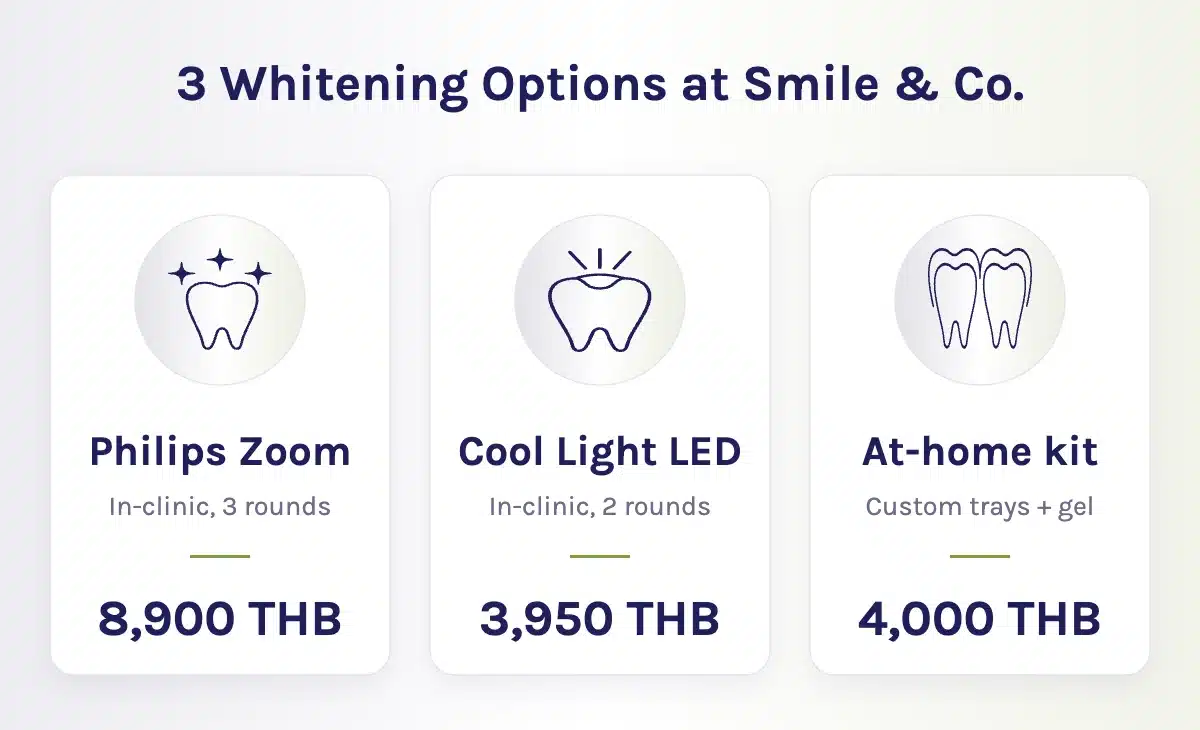
Tooth whitening uses a whitening gel, applied or supervised by a dentist (in-clinic whitening also uses light to activate it), to make yellow or dull teeth look brighter. Smile & Co. Dental Clinic in Bangkok, Thailand offers 3 tooth whitening options: Philips Zoom whitening (8,900 THB), Cool Light LED whitening (3,950 THB) and an at-home whitening kit (4,000 THB). Results usually last about 6 months to 1 year, depending on your starting shade and aftercare.
Reviewed by the Smile & Co. Dental Clinic dental team
Updated November 2026
What Is Tooth Whitening and How Does It Work?
Tooth whitening, also called tooth bleaching, makes yellow or dull teeth look whiter. The dentist applies a whitening gel to the tooth surface; for in-clinic whitening, light is used to activate it. The gel releases oxygen, which passes through the enamel and breaks down pigment that has built up inside the tooth, so the tooth looks brighter. When it is done under a dentist’s care, whitening is not generally expected to thin the enamel.
How much whiter your teeth become depends on why they changed color:
- External stains, such as tea, coffee, wine, smoking and food coloring, usually respond well to whitening.
- Internal discoloration, such as pigment that formed while the teeth were developing, staining from some antibiotics, or a dead tooth, may lighten less and sometimes needs another treatment as well.
Does Tooth Whitening Really Work?
Yes, when the discoloration is the kind that responds to whitening. How much lighter your teeth become varies from person to person, depending on your starting shade and the cause of the discoloration. Your dentist measures your shade with a shade guide before and after, so you can see the change.
Who Is Tooth Whitening Suitable For?
- People whose teeth are yellow or dull from tea, coffee, wine or smoking
- People who want a brighter smile before an important event, or whose work involves meeting people
- People with healthy teeth and no untreated tooth decay or gum inflammation
How Many Ways Can Teeth Be Whitened? 3 Options at Smile & Co. Compared
Philips Zoom
Where: At the clinic, by a dentist
Gel: Philips Zoom WhiteSpeed (25% hydrogen peroxide)
Time: 3 rounds of gel, 15 minutes each
Price: 8,900 THB
Results: Change visible after treatment; the shade settles over the next few days
Whiteness: Depends on your starting shade; some people need more than one session
Sensitivity: Medium-strength gel (25%); teeth may feel sensitive for 1–2 days
Convenience: Done at the clinic by a dentist
Good for: People who want in-clinic whitening with Philips Zoom
Cool Light LED
Where: At the clinic, by a dentist
Gel: Pola Office (35% hydrogen peroxide)
Time: 2 rounds of gel, 15 minutes each
Price: 3,950 THB
Results: Change visible after treatment; the shade settles over the next few days
Whiteness: Depends on your starting shade; some people need more than one session
Sensitivity: Stronger gel (35%); teeth may feel sensitive for 1–2 days
Convenience: Done at the clinic by a dentist
Good for: People who want in-clinic whitening with Pola Office gel
At-home kit
Where: At home, following your dentist’s instructions
Gel: Opalescence
Time: Wear the trays for the time your dentist sets, until you reach the shade you want
Price: 4,000 THB (custom trays + 1 tube of gel)
Results: Gradual; there is no fixed duration, as it depends on your starting shade and type of stain
Whiteness: Depends on your starting shade and how regularly you wear the trays
Sensitivity: Gentler gel; sensitivity can still occur, and wear time can be adjusted as your dentist advises
Convenience: You wear the trays at home regularly
Good for: People who prefer to whiten at home, or to top up after in-clinic whitening
Zoom vs Cool Light: What Is the Difference?
Both are in-clinic treatments done by a dentist, using hydrogen peroxide gel with an LED light (Philips Zoom uses the Philips Zoom WhiteSpeed system; Cool Light LED uses Pola Office gel). They differ in gel strength, how sensitivity is managed, treatment time and price.
Philips Zoom
Gel strength: 25% hydrogen peroxide
Sensitivity care: Relief ACP gel applied after whitening
Gel time: 3 rounds of 15 minutes
Whiteness: Depends on your starting shade; your dentist measures the shade before and after
Price: 8,900 THB
Cool Light LED
Gel strength: 35% hydrogen peroxide (Pola Office)
Sensitivity care: No additional desensitizing gel applied
Gel time: 2 rounds of 15 minutes
Whiteness: Depends on your starting shade; your dentist measures the shade before and after
Price: 3,950 THB
Shade change. How much whiter your teeth become depends on your starting shade, the type of staining and your own teeth. Yellow or brown stains tend to respond well, while crowns and fillings do not change color. A systematic review found that higher-concentration gels do not clearly produce a whiter result. Your dentist measures your shade with a shade guide before and after, so you can see the change.
Sensitivity and ACP. Temporary sensitivity is the most common side effect of whitening. A systematic review found sensitivity tends to be less likely with lower-concentration gels, but either option can still cause sensitivity. With Philips Zoom, your dentist applies an ACP (amorphous calcium phosphate) gel after whitening, which supplies calcium and phosphate to the tooth surface; the manufacturer states it helps ease sensitivity. Results and sensitivity vary from person to person, and your dentist will recommend the option that suits your starting shade and any sensitivity.
In-Clinic or At-Home Whitening?
In-clinic whitening gives a change you can see after treatment, but the gel is stronger, so your teeth may feel sensitive for the first 1–2 days, and some people need more than one session. At-home kits use a gentler gel: teeth whiten gradually, and how long it takes varies, but you need to wear the trays regularly. Some people whiten at the clinic first, then top up at home.
Your dentist will help you choose based on your starting shade, any sensitivity and your budget.
How Much Does Tooth Whitening Cost in Bangkok?
| Treatment | Price (THB) |
|---|---|
| Philips Zoom whitening | 8,900 |
| Zoom + dental scaling GBT Piezon | 9,900 |
| Zoom + dental scaling GBT Airflow | 10,200 |
| Cool Light LED whitening | 3,950 |
| Cool Light + dental scaling + Dental Spa Airflow | 4,500 |
| Cool Light + dental scaling GBT Piezon | 4,800 |
| At-home whitening kit (custom trays + 1 tube of Opalescence gel) | 4,000 |
Why Do Packages Include Dental Scaling?
Tartar and surface stains stop the gel from reaching the teeth evenly, so dentists usually recommend scaling before whitening. Packages combine both in one visit.
Tooth Whitening Before and After Cases: Philips Zoom and Cool Light
These are Philips Zoom and Cool Light LED whitening cases at Smile & Co. Dental Clinic. In the paired photos, the top photo is before whitening and the bottom photo is after. The single photos show teeth after whitening, next to a shade tab that matches the starting shade. Patients gave consent for their photos to be shown. Results vary from person to person, depending on the starting shade and aftercare.
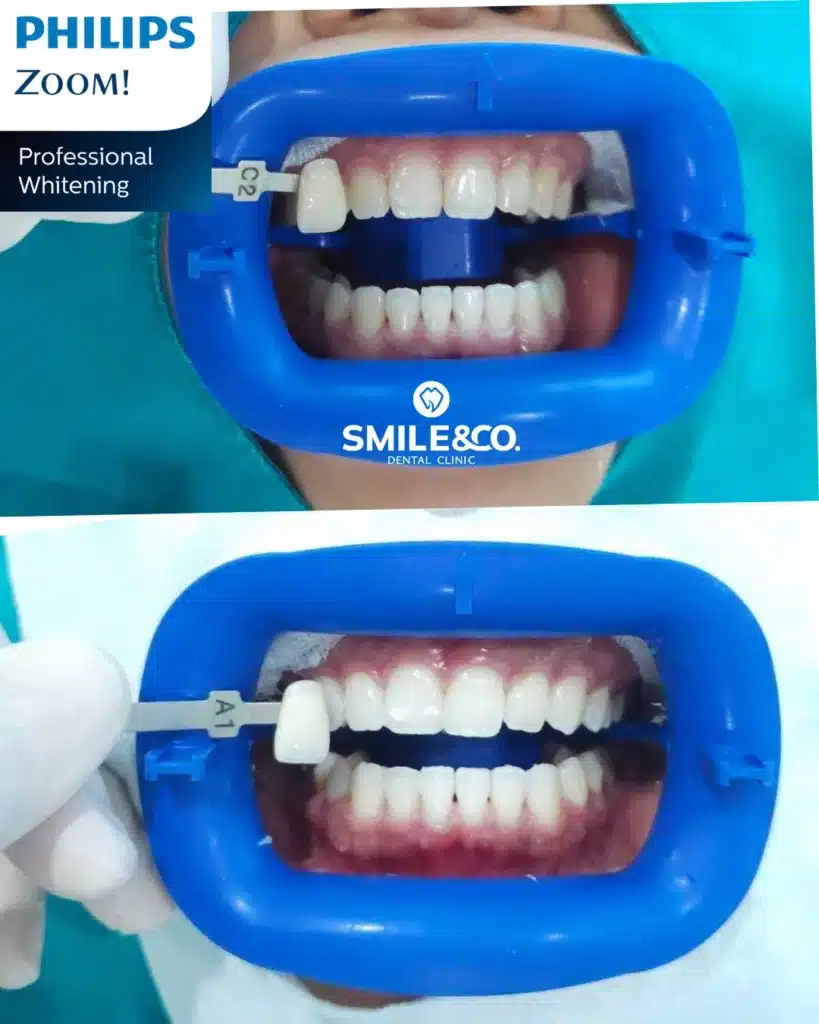
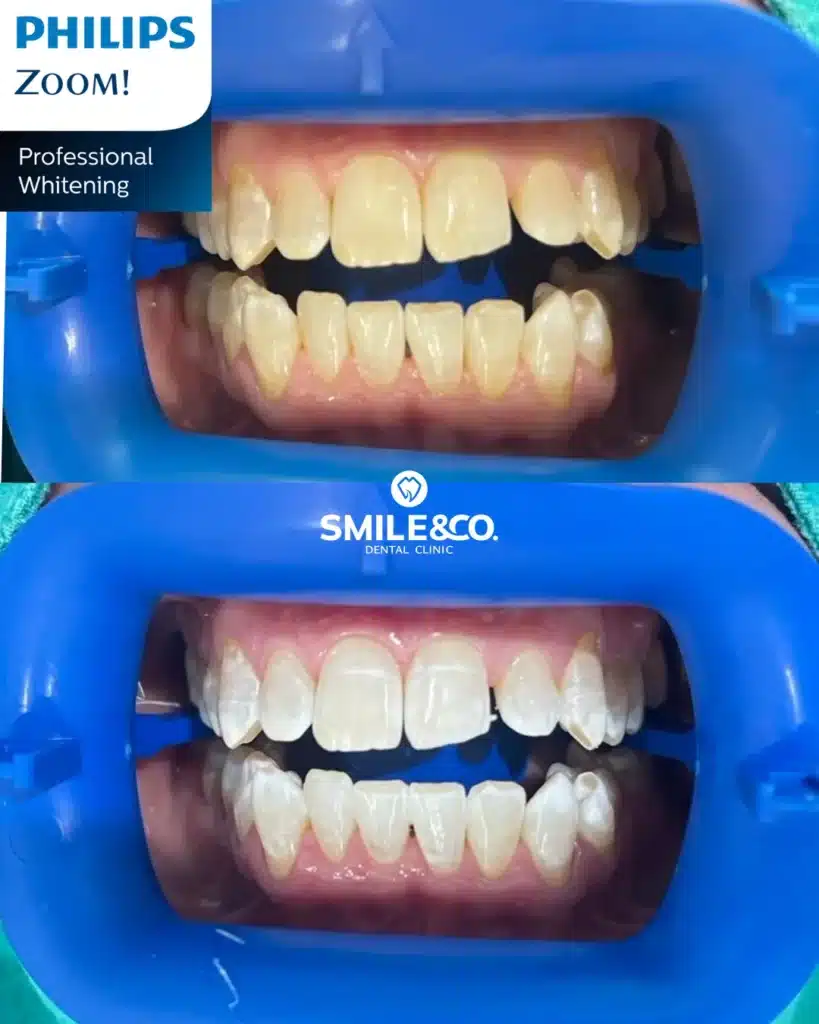
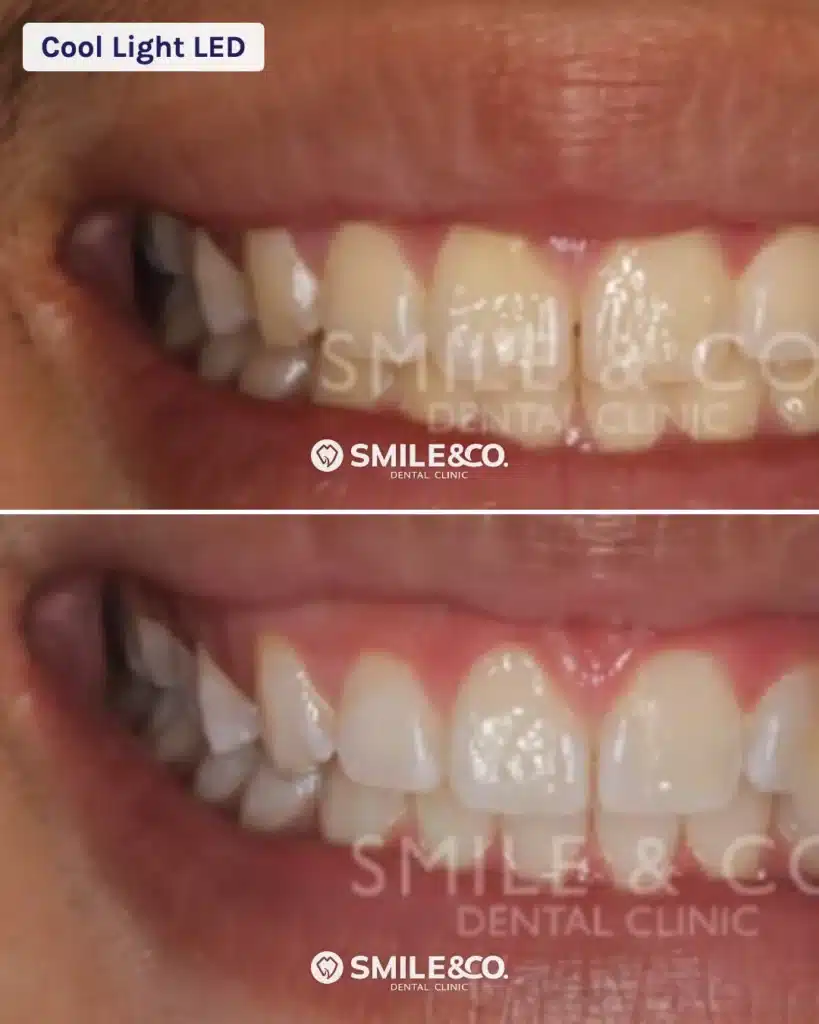
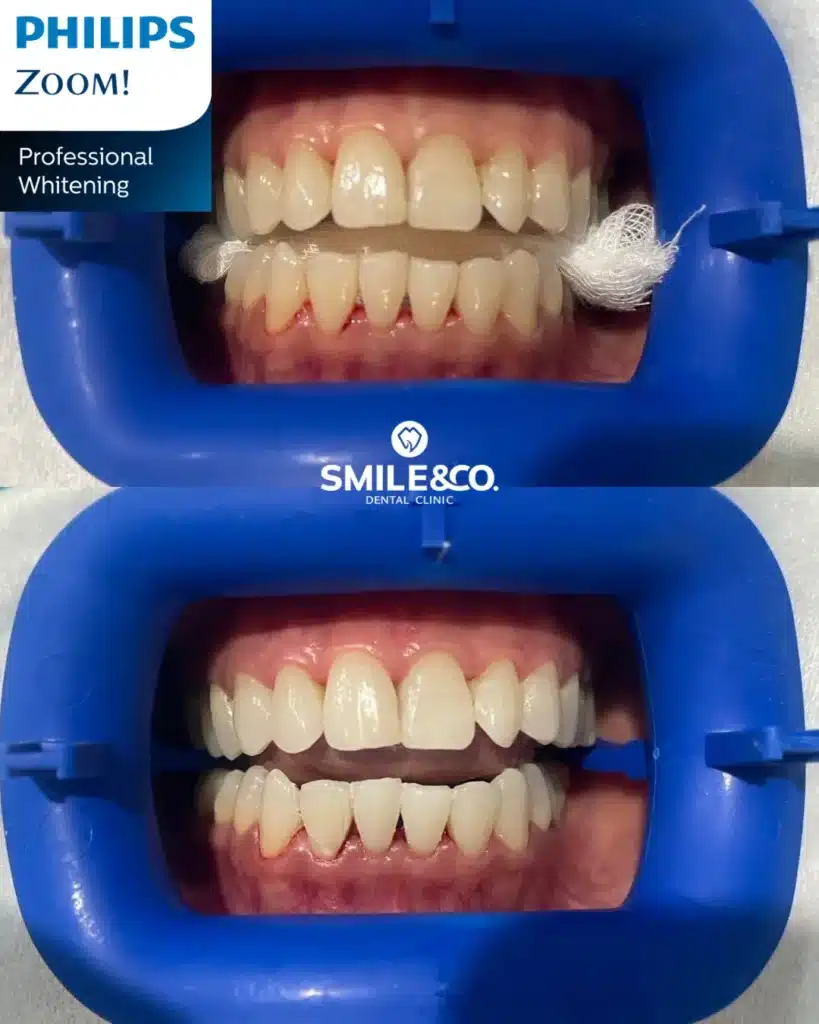
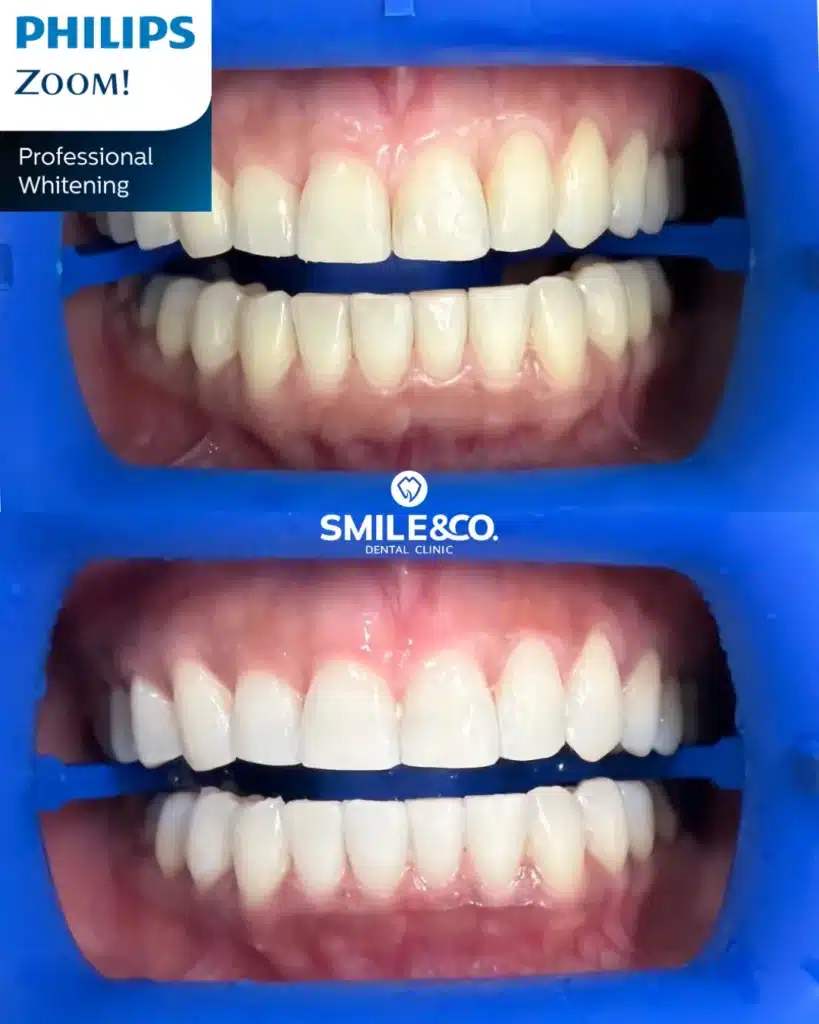
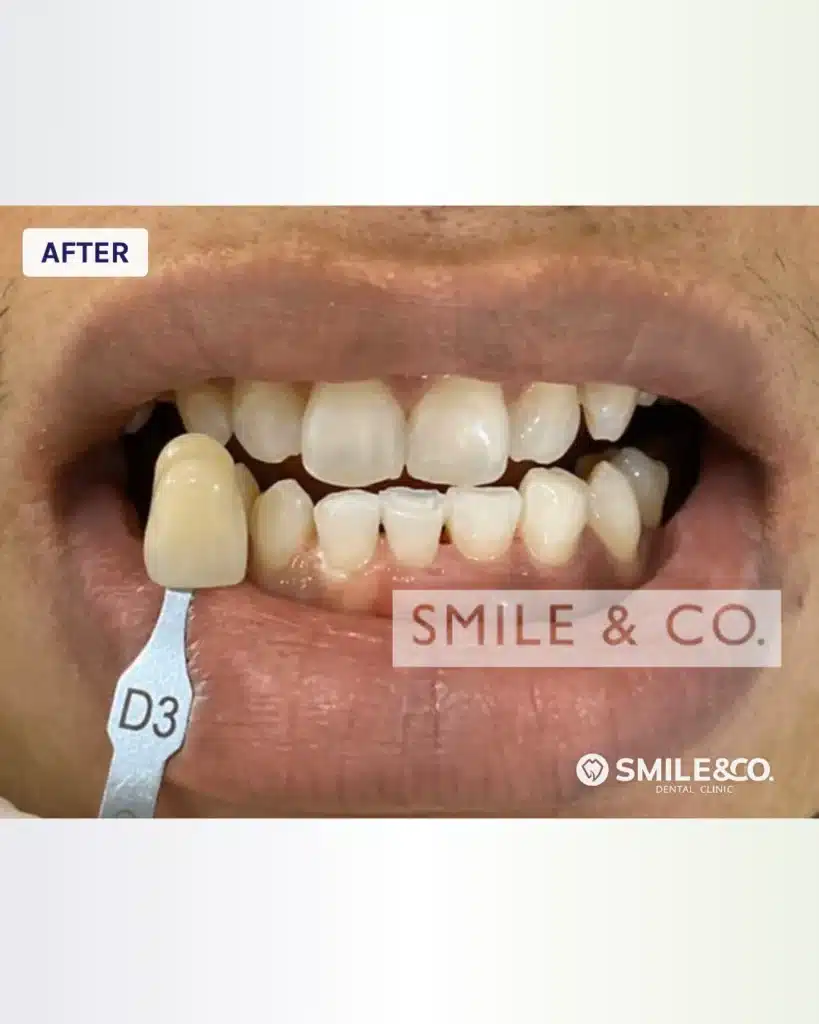
Paired photos: top before, bottom after | Single photos: after, next to a shade tab of the starting shade
What Are the Steps of In-Clinic Whitening?
- The dentist checks your oral health and measures your tooth shade with a shade guide.
- Teeth are scaled and polished first if there is tartar or staining.
- A lip retractor is placed and a protective barrier is applied to the gums.
- The whitening gel is applied and activated with light, using the system you chose (Philips Zoom or Cool Light LED).
- The gel is removed, your new shade is measured, and you receive aftercare advice.
How Does an At-Home Whitening Kit Work?
- Your dentist checks your teeth, measures the shade and takes impressions or a scan.
- You collect your custom trays and gel, and your dentist shows you how to use them.
- Put a small amount of gel in the trays, insert them, and wipe away any gel that touches your gums.
- Keep wearing them for the time your dentist sets until you reach the shade you want. How long this takes varies; deep stains, such as tetracycline staining, can take longer.
- Remove the trays, rinse, and clean your teeth and trays each time. If your teeth feel sensitive, take a break or shorten the wear time, and ask your dentist.
- Come back for a follow-up once you reach the shade you want, so your dentist can check it.
Are There Other Options Besides These 3?
- Over-the-counter products, such as whitening toothpastes, strips and gels: milder than the products dentists use, so any change is usually smaller and slower. Ask your dentist first, especially if you have sensitive teeth, fillings or crowns.
- Single-tooth (internal) whitening: for one tooth that has darkened because it is dead. It must be done by a dentist.
How Long Does Whitening Last? Will My Teeth Turn Yellow Again?
Whitening is not permanent. Results usually last about 6 months to 1 year or longer, depending on your starting shade, what you eat and drink, smoking and oral care. If your teeth darken again, you can whiten again or top up with an at-home kit, as your dentist advises.
Is Sensitivity Normal After Tooth Whitening?
Your teeth may feel sensitive after whitening. This is common and usually settles on its own within 1–2 days, occasionally a little longer. If your teeth feel sensitive, a desensitizing toothpaste or a pain reliever recommended by your dentist or pharmacist may help. If sensitivity is strong or does not improve, contact your dentist. If your teeth are already sensitive, tell your dentist before whitening. They may suggest a gentler at-home kit or a desensitizing agent.
What to Avoid After Whitening, and How to Keep Teeth White Longer
For the first 24–48 hours, the enamel surface is temporarily more permeable, so teeth may pick up stains more easily. As a precaution, avoid:
- Tea, coffee, red wine and soft drinks
- Dark fruit juices, such as grape or berry juice
- Foods with dark sauces, such as soy sauce, ketchup, curry and instant noodles
- Snacks or candies with food coloring
- Cigarettes and tobacco
To keep your teeth white for longer:
- Rinse with water after dark drinks.
- Brush and floss correctly every day.
- Stop or cut down on smoking.
- Have a check-up and cleaning every 6 months.
Tooth Whitening vs Veneers: What Is the Difference?
Tooth whitening
What it changes: Tooth color only
Tooth preparation: None
How long it lasts: About 6 months to 1 year or longer; can be repeated
Good for: Yellow teeth from staining, when tooth shape is already good
Veneers
What it changes: Both color and shape
Tooth preparation: Usually a thin layer of enamel is removed, which cannot be undone (minimal with some types)
How long it lasts: Many years, depending on the material and care
Good for: Dark teeth that do not whiten well, chipped or gapped teeth, or changing tooth shape
Neither option is better for everyone. If you only want whiter teeth and are happy with their shape, whitening is usually the first choice because no tooth preparation is needed. Veneers suit people who want to change both color and shape. If you are planning veneers, whiten first, wait about 2 weeks for the shade to settle, then match the veneers to your other teeth. Your dentist will examine your teeth and recommend what suits you. Read more about veneers.
Who Should Avoid Whitening or Ask a Dentist First?
- Pregnant or breastfeeding women
- Children under 16, because the tooth pulp is still large and can be irritated more easily
- People with untreated gum inflammation or gum disease
- People with tooth decay or strong sensitivity, who should have it treated or ask a dentist first
- People with fillings, crowns or veneers on the front teeth, because these materials do not change color with the teeth
How to Choose a Tooth Whitening Clinic
- The clinic is licensed, and a dentist assesses your teeth and supervises the whitening.
- The clinic tells you which system and gel it uses, and what the price includes.
- Your teeth are checked, and cleaned if needed, before whitening.
- You get aftercare advice and can contact the clinic if sensitivity occurs.
Tooth Whitening at Smile & Co. Dental Clinic
- Philips Zoom, Cool Light LED (Pola Office gel) and at-home kits (Opalescence)
- Your dentist checks your teeth and measures the shade before every whitening
- Packages with GBT dental scaling
- English-speaking dentists
- Wannasorn Tower, 3rd floor, near BTS Phaya Thai Exit 4, Bangkok, Thailand. Open every day. Call +66 82 787 7444 or message us on LINE @smileandco.
Tooth Whitening FAQs
What is the difference between Zoom and Cool Light whitening?
Zoom and Cool Light whitening are both done at the clinic by a dentist; they differ in gel and time. Philips Zoom uses 25% hydrogen peroxide gel in 3 rounds of 15 minutes, followed by an ACP gel intended to ease sensitivity, and costs 8,900 THB. Cool Light LED uses Pola Office gel at 35% in 2 rounds of 15 minutes and costs 3,950 THB. How white your teeth become depends on your starting shade, and your dentist will help you choose.
How much does tooth whitening cost in Bangkok, Thailand?
At Smile & Co. in Bangkok, Cool Light LED whitening is 3,950 THB, Philips Zoom whitening is 8,900 THB, the at-home kit is 4,000 THB, and packages with dental scaling cost 4,500–10,200 THB.
Can I whiten my teeth while wearing braces?
Whitening is not recommended while you wear braces, because the areas under the brackets would not be whitened, leaving uneven color. Whiten about 3–6 months after your braces come off. With clear aligners, the aligners can sometimes be used as whitening trays; ask your dentist whether this suits you. Read more about orthodontic treatment.
Can yellow teeth be whitened?
Yes. Yellow teeth from tea, coffee or smoking usually respond well. Teeth that are yellow from inside, for example from some antibiotics, may lighten less. Your dentist will assess them first.
How many whitening sessions will I need?
The number of whitening sessions depends on your starting shade. Some people see a change after one session; others need 2–3 sessions or an at-home kit afterward. Your dentist will assess this before you start.
Does whitening make the enamel thinner?
When it is done under a dentist’s care, whitening is not generally expected to thin the enamel. The gel reacts with pigment inside the tooth.
Does tooth whitening hurt?
Whitening is not usually painful, but your teeth may feel sensitive during or after whitening. This usually settles within 1–2 days.
Can I wear my retainer after whitening?
Yes, you can wear your retainer as usual after whitening; there is no restriction. Just clean your retainer daily so stains don’t build up.
What can I eat after whitening?
For the first 24–48 hours after whitening, choose light-colored foods such as rice, chicken, fish, egg whites and milk. Avoid tea, coffee, dark sauces and instant noodles.
Can I use mouthwash after whitening?
Yes, you can use mouthwash after whitening. Choose a gentle, alcohol-free, dye-free mouthwash.
How long does tooth whitening last?
Whitening results usually last about 6 months to 1 year or longer, depending on what you eat and drink, smoking and oral care. If your teeth darken again, you can whiten again or top up with an at-home kit.
Can crowns, veneers or fillings be whitened?
No. Crowns, veneers and fillings do not change color with whitening gel. If you are planning new crowns or veneers, whiten first, wait about 2 weeks for the shade to settle, then match the new restoration to your whiter shade.
Tooth whitening or veneers: which should I choose?
Neither is better for everyone. Whitening changes only tooth color and needs no tooth preparation, so it suits yellow teeth from staining when the tooth shape is already good. Veneers change both color and shape, so they suit dark teeth that do not whiten well, chipped teeth or gaps. Your dentist will examine your teeth and recommend what suits you.
Tooth Whitening Summary
Tooth whitening can brighten teeth that are yellow from tea, coffee or smoking. Your dentist at Smile & Co. will check your teeth and help you choose between Philips Zoom, Cool Light LED and an at-home kit.
References
- Maran BM, et al. In-office bleaching with low/medium vs. high concentrate hydrogen peroxide: a systematic review and meta-analysis. J Dent. 2020;103:103499. doi:10.1016/j.jdent.2020.103499
- Philips. Zoom! WhiteSpeed Procedure Kit, Instructions for Use.
- Eachempati P, et al. Home-based chemically-induced whitening (bleaching) of teeth in adults. Cochrane Database Syst Rev. 2018;12(12):CD006202. doi:10.1002/14651858.CD006202.pub2
- Berger SB, et al. Enamel susceptibility to red wine staining after 35% hydrogen peroxide bleaching. J Appl Oral Sci. 2008;16(3):201–204. doi:10.1590/S1678-77572008000300007
- Khashashneh M, et al. The effectiveness of dental bleaching during orthodontic treatment with clear aligners: a systematic review. Appl Sci. 2022;12(21):11274. doi:10.3390/app122111274