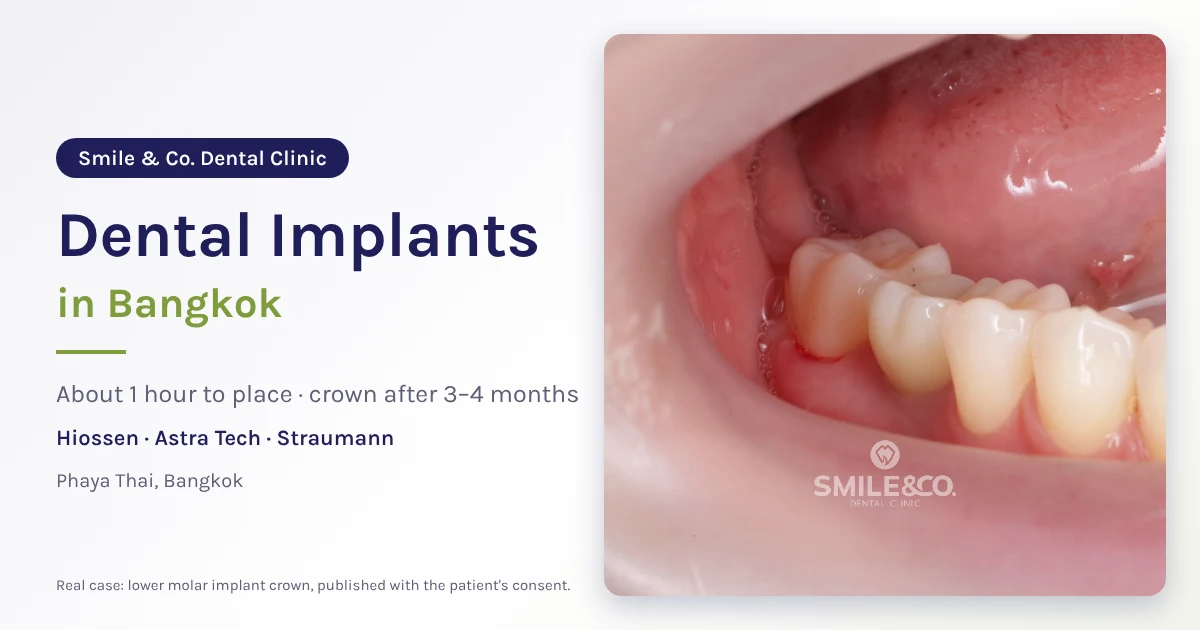
A real dental implant case at Smile & Co. Dental Clinic, shared with consent. Results vary from person to person.
A dental implant is a titanium post placed in the jawbone where a tooth is missing. Once the bone has bonded to the implant, a crown is fitted on top. The result is a fixed (non-removable) tooth that does not require drilling the neighbouring teeth. At Smile & Co. Dental Clinic in Bangkok (about 2 minutes’ walk from BTS Phaya Thai), placing an implant takes about 1 hour under local anaesthetic, and the crown is fitted after about 3–4 months of healing. Prices start at 39,000 THB per tooth including a ceramic or zirconia crown (X-ray/CT, impression or scan, medicines, sterilisation fee and any bone graft not included), payable in 3 instalments that follow the treatment steps.
Reviewed by Dr. Thanapol Ariyanuntaka, oral and maxillofacial surgeon (DDS, Mahidol University · Diplomate, Thai Board of Oral and Maxillofacial Surgery) · Updated November 2026
- Implants placed by an oral and maxillofacial surgeon
- 3 implant brands: Hiossen · Astra Tech · Straumann, crown included in the price
- Clinic warranty on the implant: lifetime for Astra Tech and Straumann, 5 years for Hiossen (conditions apply, see prices; not a guarantee of treatment results)
- In-house CT scan for implant planning
- First consultation free (X-ray charged separately)
What is a dental implant?
A dental implant replaces the root of a missing tooth. It is usually made of titanium and is placed in the jawbone. Over the following months the bone bonds to the implant surface, a process called osseointegration. A connector (abutment) and a crown are then attached, so the implant replaces both the visible tooth and the root below the gum. You may also see it called “implant tooth replacement” or simply “an implant”.
Implants can replace a single tooth, several teeth or a full arch, and can also anchor a bridge or a full denture so it stays firmly in place.
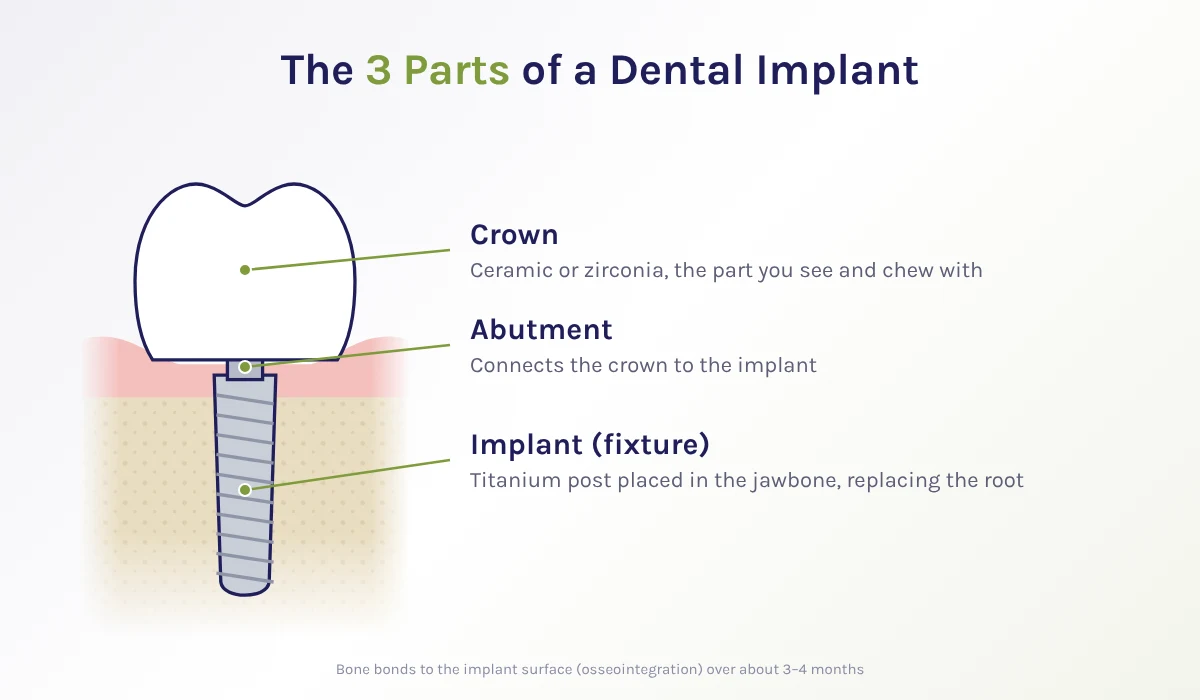
The parts of a dental implant
- Implant (fixture): a screw-shaped titanium post in the jawbone that acts as the root.
- Abutment: the connector between the implant and the crown.
- Crown: the part you see and chew with. Smile & Co. uses ceramic or zirconia crowns, colour-matched to your other teeth.
Why replace a missing tooth?
After a tooth is removed and not replaced, the bone in that area gradually shrinks. A systematic review found that in the first 6 months after extraction, the ridge loses about 29–63% of its width and 11–22% of its height, with the fastest change in the first 3–6 months. Neighbouring teeth can tip into the gap and the opposing tooth can over-erupt, which changes your bite, makes chewing harder and traps food. A missing front tooth also affects your smile and speech.
There are several ways to replace a tooth. An implant is one option that does not require drilling the neighbouring teeth, and it transfers chewing forces into the jawbone. An implant does not restore bone that has already been lost; a bone graft may be needed.
Who is a good candidate for dental implants?
- You have one or more missing teeth, front teeth or molars, and healthy neighbouring teeth that you would rather not drill for a bridge.
- Your removable denture is loose and you lack confidence when eating or speaking.
- A tooth cannot be saved, for example a tooth cracked into the root or decayed beyond repair or root canal treatment.
- Your jaw has stopped growing, usually from about age 18. Some people, especially men, keep growing into their early 20s, so the dentist assesses each case. Older adults can have implants too; overall health matters more than age.
- Your gums are healthy, or gum disease has been treated and is under control.
When extra assessment or a delay is needed
These conditions do not always rule out implants, but they raise the risk. The dentist will assess you individually and may consult your doctor first.
- Smoking: the more you smoke, the higher the risk. A meta-analysis found that smoking more than 10 cigarettes a day raises the risk of implant failure about 2.4 times compared with non-smokers (counted per implant).
- Poorly controlled diabetes: with good blood sugar control, results are close to those of people without diabetes. The dentist will plan with your doctor.
- Untreated gum disease: it should be treated and stable first, because people with a history of periodontitis have about 1.9 times the risk of losing an implant and about 2.2 times the risk of peri-implantitis. Even after treatment, more frequent check-ups are advised.
- Radiotherapy to the head and neck: the risk of implant failure is clearly higher. Treatment must be planned with your doctor, and some cases are better treated in hospital.
- Medicines for osteoporosis, or certain cancer treatments (tablets or injections): always tell your dentist. Most people taking osteoporosis medicines can still have implants, but high doses given for cancer carry a much higher risk of jawbone complications, so your doctor must be involved first.
- Teeth grinding (bruxism): may increase the risk to the implant and crown. A night guard may be recommended.
- Pregnancy: implant surgery is usually postponed until after delivery.
- Thin or insufficient bone: a bone graft or sinus lift may be needed first.
Types of dental implant treatment
- By number of teeth: a single implant for one tooth · an implant-supported bridge (2 or more implants holding several teeth) · full-arch implants such as All-on-4, All-on-5 and All-on-6, which use 4–6 implants to hold a whole arch.
- By timing of placement: after the extraction site has healed, or right after extraction (immediate implant) in suitable cases. See the next section.
- By timing of the crown: the conventional approach waits more than 2 months for the bone to bond before fitting the crown, and it has the most long-term data. Immediate or same-day crowns (“One Day Implant”) suit only carefully selected cases. At Smile & Co. Dental Clinic, single and multiple implants follow the conventional approach, with the crown fitted after about 3–4 months, and the clinic does not offer One Day Implants.
- By brand: brands differ in implant surface and design, long-term research and warranty. See “Which implant brand should I choose?” below.
Full-arch dental implants (All-on-4, All-on-5, All-on-6)
If all or nearly all teeth in a jaw are missing, or a full denture is loose, the dentist may use 4–6 implants to hold a new set of teeth for the whole arch. The number of implants depends on the amount of bone, assessed on a CT scan. At Smile & Co. Dental Clinic, prices start from 315,000 THB for All-on-4, 360,000 THB for All-on-5 and 390,000 THB for All-on-6 per arch, including the permanent teeth. The permanent teeth are fitted about 3 months after the implants are placed, and a temporary denture, usually fitted on the day the implants are placed, is worn while you wait (25,000 THB per arch, charged separately from the All-on price). Read more about All-on-4 dental implants.
Can an implant be placed right after extraction (immediate implant)?
An immediate implant means the tooth is removed and the implant is placed into the socket in the same surgery, instead of waiting for the extraction site to heal first. Smile & Co. Dental Clinic offers immediate implants in suitable cases, with no extra charge for immediate placement (the extraction, and bone graft material if needed, are charged separately; see prices).
Who is suitable for an immediate implant?
For upper front teeth, ITI (International Team for Implantology) guidance says immediate placement should be considered only when all of the following are present, which is uncommon:
- the bone walls around the socket are intact
- the bone on the cheek side is at least about 1 mm thick, and the gum is fairly thick
- there is no acute infection at the tooth being removed
- there is enough bone below and around the socket for the implant to be stable on the day it is placed
- the implant can be placed in the correct position
If these conditions are not met, for example very thin cheek-side bone or an acute abscess, the dentist will recommend removing the tooth and letting the site heal first, which is safer.
Immediate implant steps
- X-ray and CT scan to check the bone around the tooth to be removed.
- Careful extraction to preserve the bone around the socket, then cleaning of the socket.
- The implant is placed in the socket. Any gap between the implant and the bone wall may be filled with bone graft material.
- The site is closed and the bone bonds to the implant over about 3–4 months.
- Impression or scan, then the crown is fitted.
The advantages are fewer surgeries and a shorter overall treatment time. A systematic review found about 98% of implants placed right after extraction still in use at 2 years, but there is less long-term data than for implants placed in healed sites, and in upper front teeth about 1 in 4 cases (range 9–41%) show 1 mm or more of gum recession at the front within 1–3 years, so careful case selection matters. An immediate implant means immediate placement of the implant, not a tooth on the same day; the crown is still fitted after about 3–4 months of healing.
Which implant brand should I choose?
There are dozens of implant brands. Smile & Co. Dental Clinic uses three brands.
- Hiossen (USA): part of the Osstem group from Korea. The most affordable of the three. Clinic warranty on the implant: 5 years.
- Astra Tech (Sweden): now part of Dentsply Sirona. Clinic warranty on the implant: lifetime.
- Straumann (Switzerland): clinic warranty on the implant: lifetime.
No brand is better for everyone. Brands differ in design, long-term research, price and warranty. The right brand depends on the tooth position, the amount of bone, your budget and the treatment plan. The dentist will advise you after an X-ray or CT scan.
Dental implant procedure step by step
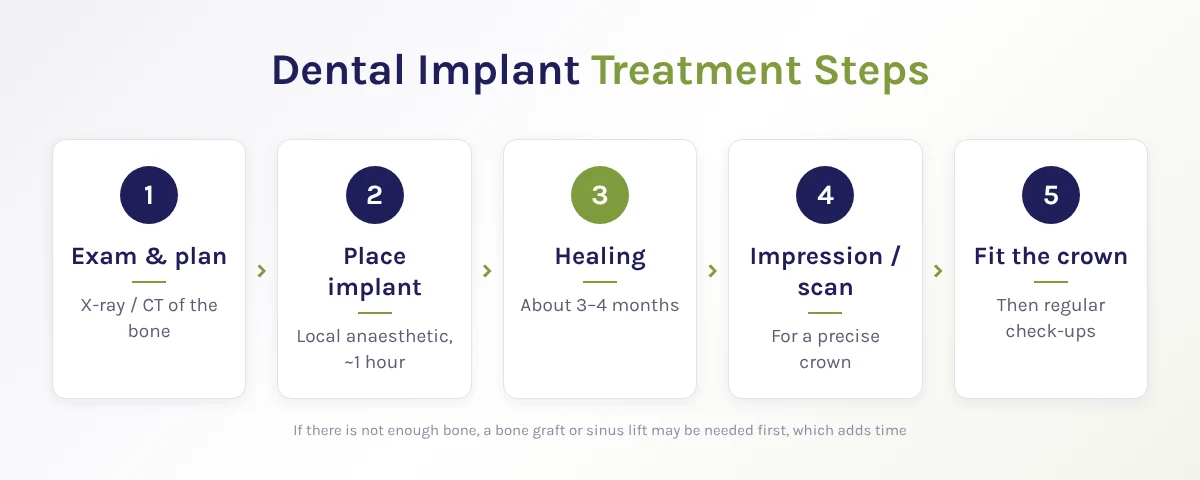
- Examination and planning: the dentist examines your mouth and takes an X-ray and, when needed, a CT scan to check the height and width of the bone and the position of nerves or the sinus, then plans the implant position and size. In some cases a digital guide is used to plan and guide the surgery (see below).
- Site preparation (if needed): if there is not enough bone, a bone graft or sinus lift may be done before or at the same time as the implant.
- Implant placement: done under local anaesthetic and takes about 1 hour (longer for several implants or a bone graft). The dentist opens the gum, prepares the bone, places the implant and closes the gum with stitches.
- Healing: about 3–4 months while the bone bonds to the implant. You can carry on with daily life and come back for check-ups as advised.
- Impression or scan: to make a crown that fits your bite and neighbouring teeth.
- Crown fitting: the ceramic or zirconia crown is attached to the abutment, the bite is adjusted, and regular check-ups follow.
What is a digital (guided) dental implant?
A digital implant, or guided implant surgery, combines the CT scan with a 3D scan of your mouth so the dentist can plan the implant position, size, depth and angle on a computer. A surgical guide is then printed to fit your teeth, and during surgery it guides the drilling and implant placement to match the plan.
Benefits and limits
- The implant ends up close to the planned position. A meta-analysis found an average deviation of about 1.2 mm at the entry point, 1.4 mm at the tip and about 3.5 degrees. Some deviation is still possible with a guide.
- It helps plan around the lower jaw nerve and the sinus before surgery.
- You can see a simulation of the implant position and the final teeth before treatment starts, which is useful for front teeth and multiple implants.
- A meta-analysis of 4 studies (597 implants, average follow-up about 2 years) comparing guided and non-guided placement found similar bone loss around the implant, complications and implant survival, so a guide is not needed in every case. The dentist will advise when it helps.
A digital guide costs an extra 6,000–8,000 THB; the dentist will confirm the cost for your case before treatment.
How long does a dental implant take?
When the bone is ready, it takes about 3–4 months from placing the implant to fitting the crown. The main appointments are the planning visit, implant placement (about 1 hour), a wound check, the impression or scan, and the crown fitting. A bone graft, sinus lift or waiting for an extraction site to heal adds time. If the implant can be placed right after extraction (immediate implant), there is no wait for the extraction site to heal. The dentist will give you your own timeline after the examination.
During the 3–4 month wait, single or multiple implants do not get a temporary tooth, except for front teeth, where a removable temporary denture can be fitted from 5,000 THB. The dentist takes an impression before the extraction and fits the temporary denture after it. This temporary tooth is not attached to the implant.
Living abroad? How to get dental implants in Bangkok
The bone needs about 3–4 months to bond to the implant before the crown is fitted, so patients who live abroad usually split treatment into 2 trips.
Before you travel: contact us on WhatsApp +66 82 787 7444, LINE @smileandco or email (smileandcodentalclinic@gmail.com), and send any X-rays or CT scans you have plus photos of your teeth. The dentist will give a preliminary assessment through an online consultation and help plan your appointments around your stay in Bangkok. The information and images you send are used only for the dentist’s assessment.
Trip 1: examination, planning and implant placement
- Examination, X-ray and CT scan at the clinic, then the treatment plan.
- Implant placement. If a tooth still needs to be removed and the site is suitable, it may be removed and the implant placed the same day (immediate implant).
- Stay in Bangkok for the wound check the dentist schedules before you fly home.
The 3–4 month wait (at home)
- Follow the cleaning instructions. If anything seems unusual, send photos or contact the clinic.
- For a front tooth, a removable temporary denture can be worn while you wait (from 5,000 THB); the impression for it is taken on trip 1 before the extraction.
Trip 2: crown fitting
- Impression or scan, then about 1 week for the lab to make the crown, after which the ceramic or zirconia crown is fitted and the bite is adjusted.
- Plan to stay in Bangkok for at least 1 week on this trip.
If a bone graft or sinus lift is needed first, the wait may be longer or an extra visit may be needed. The dentist will tell you how many days to plan for each trip after assessing your case.
Do dental implants hurt?
The dentist uses local anaesthetic, so most people feel only the injection, then pressure or vibration during the procedure. After the anaesthetic wears off, there may be some pain and swelling, usually worst in the first 1–3 days. A small study of 40 implant patients found pain had mostly settled after about 3 days and swelling after about 5 days. Swelling may last longer if a bone graft is done at the same time. The dentist will prescribe pain relief as needed. Come back if pain or swelling increases after day 3, or if you have a fever or bleeding that does not stop.
How long do dental implants last?
Most dental implants last at least 10 years. Systematic reviews found about 95% of dental implants still in use at 10 years (96.4% in Howe 2019 and 95.2% in Jung 2012). Counting patients lost to follow-up, the figure is about 93%, and a review with an average follow-up of 13.4 years found 94.6% still in use. These figures count implants still in place, not implants that never had a problem. How long an implant lasts depends on cleaning, not smoking, managing medical conditions and attending check-ups.
The crown on an implant usually needs repair or replacement sooner than the implant itself (about 89% of implant crowns are still in use at 10 years). Possible problems include a loose screw, a crown coming off or chipped ceramic, and most can be fixed without replacing the implant.
At Smile & Co. Dental Clinic, the clinic’s warranty on the implant is lifetime for Astra Tech and Straumann and 5 years for Hiossen, with a 1-year warranty on the crown (see the conditions under prices).
Advantages and disadvantages of dental implants
The main drawbacks are minor surgery, about 3–4 months or more before the final tooth, a higher cost per tooth than a removable denture, and the need for good cleaning and regular check-ups to prevent inflammation around the implant.
Advantages
- Fixed in the bone, no need to remove it, and you can chew with confidence.
- No drilling of neighbouring teeth, unlike a bridge.
- Chewing forces go into the jawbone in that area.
- Cleaned much like natural teeth, with brushing and flossing.
- Long-term data: about 95% of implants still in use at 10 years.
Disadvantages and limitations
- Requires minor surgery and several months before the final tooth.
- Costs more per tooth than a removable denture.
- If bone is insufficient, a bone graft or sinus lift adds cost and time.
- Inflammation around the implant (peri-implantitis) can develop if cleaning is poor. A systematic review found an average of about 22% of patients affected (figures vary widely between studies), and people who attend regular check-ups have less inflammation.
- Gum inflammation around the implant (peri-implant mucositis) is common, on average about 43% of patients, and is usually reversible if treated early.
- Over 5 years, about 9% of implant crowns have a loose screw, about 4% come off and about 3.5% have chipped ceramic; most can be repaired.
- A small number of implants do not bond to the bone at first. The dentist removes the implant, lets the area heal and plans a new one.
- Uncommon complications include injury to a nerve in the lower jaw, or sinus problems, which is why the dentist plans with an X-ray or CT scan first.
Dental implant vs bridge vs removable denture
| Dental implant | Bridge | Removable denture | |
|---|---|---|---|
| How it is held | Fixed in the bone | Fixed to neighbouring teeth | Rests on the gum, removable |
| Drilling neighbouring teeth | Not needed | Needed for crowns | Not needed, or minimal |
| Surgery | Minor surgery | None | None |
| Time | About 3–4 months or more | No wait for bone healing | No wait for bone healing |
| Stability when chewing | Close to a natural tooth | Good | Lower, may loosen |
| Lifespan | About 95% of implants and 89% of implant crowns in use at 10 years | About 89% in use at 10 years | Often needs adjusting or remaking |
| Starting cost | Highest of the three | Medium | Lowest |
Dental implant
How it is held: Fixed in the bone
Drilling neighbouring teeth: Not needed
Surgery: Minor surgery
Time: About 3–4 months or more
Stability when chewing: Close to a natural tooth
Lifespan: About 95% of implants and 89% of implant crowns in use at 10 years
Starting cost: Highest of the three
Bridge
How it is held: Fixed to neighbouring teeth
Drilling neighbouring teeth: Needed for crowns
Surgery: None
Time: No wait for bone healing
Stability when chewing: Good
Lifespan: About 89% in use at 10 years
Starting cost: Medium
Removable denture
How it is held: Rests on the gum, removable
Drilling neighbouring teeth: Not needed, or minimal
Surgery: None
Time: No wait for bone healing
Stability when chewing: Lower, may loosen
Lifespan: Often needs adjusting or remaking
Starting cost: Lowest
If the neighbouring teeth already have crowns or large fillings, a bridge is a sensible option. If several teeth are missing and you are not ready for surgery, read more about dentures. The dentist will explain the pros and cons of each option for your teeth and budget.
Dental implant cases at Smile & Co.
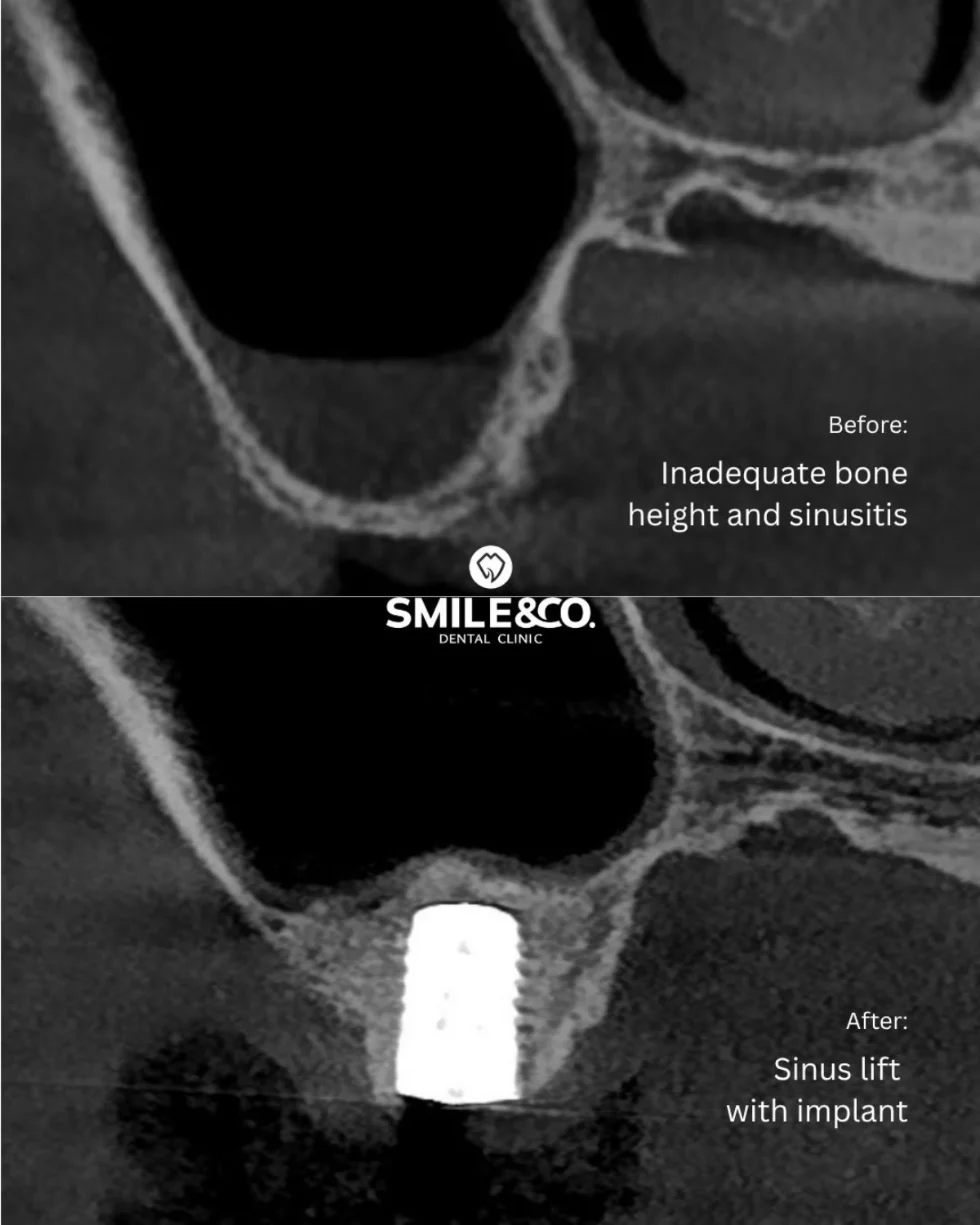
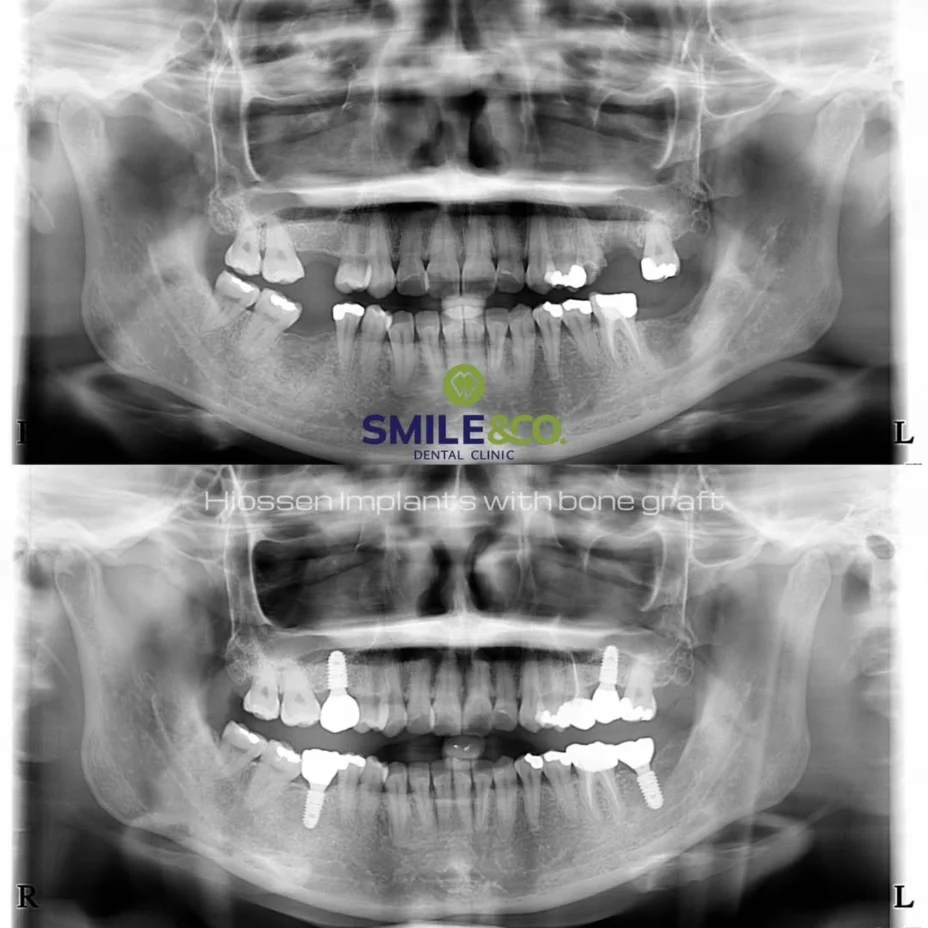
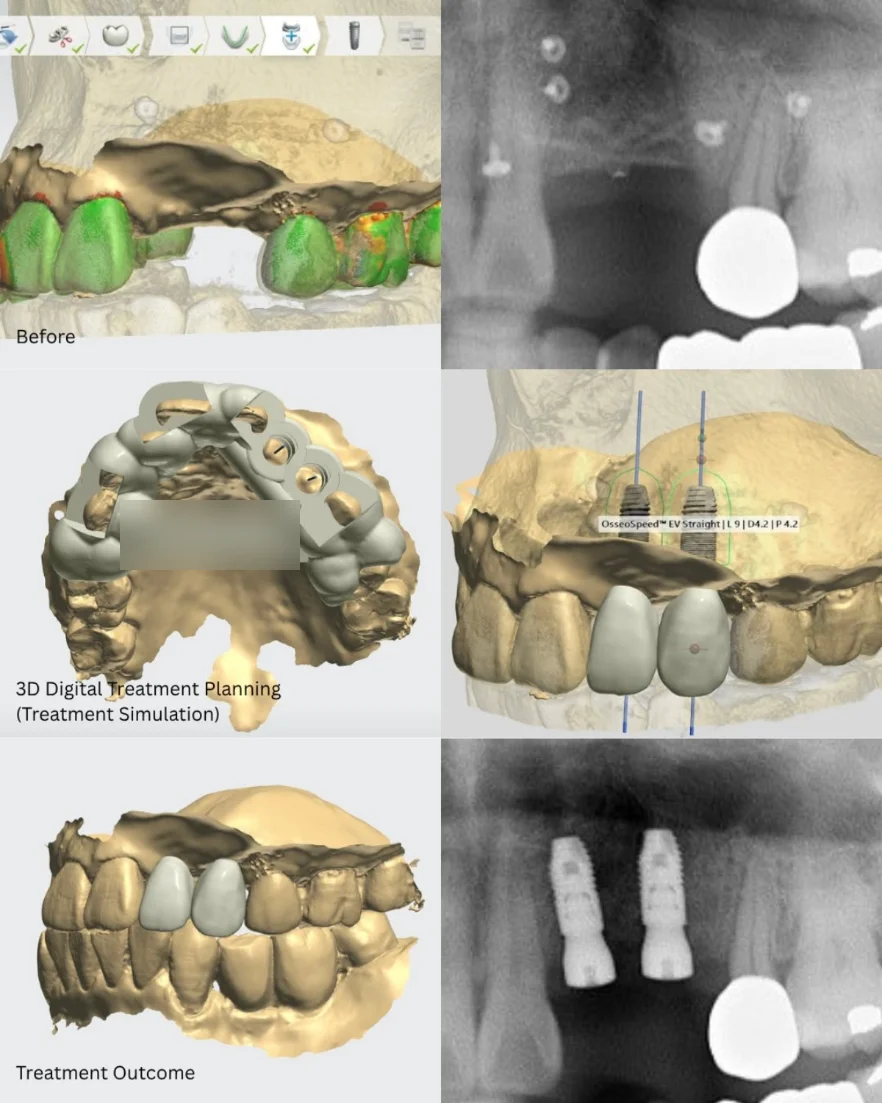
Real Smile & Co. Dental Clinic patient cases, shared with consent. Results vary from person to person.
How to prepare for dental implant surgery
- Tell the dentist about all medical conditions, regular medicines and allergies, especially blood thinners, osteoporosis medicines and any radiotherapy.
- Have any decay or gum disease treated first.
- If you smoke, stop or cut down before and after surgery.
- Eat normally before your appointment and get enough rest.
Dental implant aftercare
Right after placement
- Bite on gauze as instructed and use a cold compress on the cheek on the first day.
- Eat soft food that is not too hot and chew on the other side.
- Avoid smoking and alcohol while the wound heals.
- Brush as usual but be gentle around the wound. Use a mouthwash only as the dentist advises.
- Come back for your wound check as scheduled.
Long term, after the crown
- Brush twice a day and clean around the implant every day with floss or an interdental brush.
- Have check-ups and professional cleaning around the implant at least every 5–6 months, or more often if the dentist assesses a higher risk.
- If you grind your teeth, ask about a night guard to protect the crown.
- See the dentist if the gum around the implant is swollen, red or bleeding, or if the tooth feels loose.
Dental implant cost in Bangkok
Price per tooth, including the implant, abutment and a ceramic or zirconia crown. You can pay in 3 instalments that follow the treatment steps: the 1st on the day of implant placement, the 2nd at the impression or scan, and the 3rd when the crown is fitted.
| Implant brand | Price incl. crown (THB) | 3 instalments (THB) | Clinic warranty on the implant |
|---|---|---|---|
| Hiossen (USA) | 39,000 | 20,000 / 9,500 / 9,500 | 5 years |
| Astra Tech (Sweden) | 59,000 | 30,000 / 14,500 / 14,500 | Lifetime |
| Straumann (Switzerland) | 65,000 | 35,000 / 15,000 / 15,000 | Lifetime |
Hiossen (USA)
Price incl. crown (THB): 39,000
3 instalments (THB): 20,000 / 9,500 / 9,500
Clinic warranty on the implant: 5 years
Astra Tech (Sweden)
Price incl. crown (THB): 59,000
3 instalments (THB): 30,000 / 14,500 / 14,500
Clinic warranty on the implant: Lifetime
Straumann (Switzerland)
Price incl. crown (THB): 65,000
3 instalments (THB): 35,000 / 15,000 / 15,000
Clinic warranty on the implant: Lifetime
Full-arch implants: All-on-4 from 315,000 THB · All-on-5 from 360,000 THB · All-on-6 from 390,000 THB per arch, including the permanent teeth.
Charged separately
- X-ray and CT scan (CT 2,000–4,000 THB)
- Impression or digital scan
- Medicines
- Sterilisation fee: 50 THB per visit
- Bone graft from 10,000 THB, and sinus lift if needed
- Temporary front tooth while you wait, from 5,000 THB
- Tooth extraction (for immediate implants)
- Digital guide (optional): 6,000–8,000 THB; the dentist will confirm the cost for your case before treatment
Warranty conditions: if the implant needs to be replaced within the warranty period, only a surgical fee applies, with no charge for a new implant, abutment or crown. The implant warranty starts on the day the implant is placed, and the crown has a 1-year warranty from the day it is fitted. This is the clinic’s warranty on the implant fixture, not a guarantee of treatment results.
The first consultation is free (X-ray charged separately). See the full dental price list.
Dental implant center in Bangkok: Smile & Co.
- Implants placed by an oral and maxillofacial surgeon.
- In-house X-ray and CT scan to plan the implant position before surgery.
- Crowns and follow-up care at the same clinic, together with our gum specialist and general dentistry team.
- About a 2-minute walk from BTS Phaya Thai, Exit 4.
Your Implant Surgeon