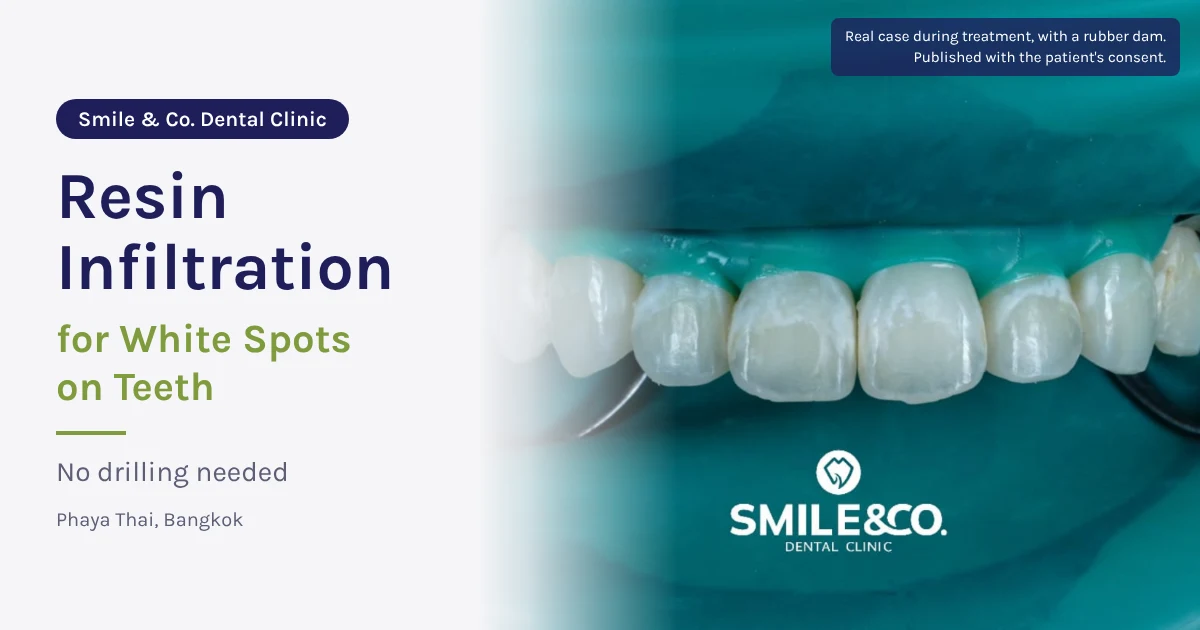
Real Smile & Co. Dental Clinic case during treatment, with a rubber dam. Published with the patient’s consent.
Resin infiltration treats chalky white spots on teeth. A runny resin soaks into the tiny pores inside the enamel, so the spot fades. Many spots blend in with the rest of the tooth, and some fade only partly. There is no drilling, and usually no injection. It works well for white spots after braces, early decay that has not become a cavity, and mild to moderate fluorosis. At Smile & Co. Dental Clinic in Phaya Thai, Bangkok, we use Icon (DMG, Germany). It takes about 30 minutes per tooth and costs 4,000 THB per tooth, or 3,500 THB per tooth when 4 or more teeth are treated on the same day.
Reviewed by the Smile & Co. Dental Clinic dental team · Updated November 2026
What is resin infiltration?
Resin infiltration is a way to treat white spots on teeth without drilling. The dentist applies a gel that gently opens up the outer surface of the enamel, then a special runny resin that soaks into the spot, and hardens it with a curing light. A widely used product is Icon by DMG (Germany), so many people call it Icon resin infiltration or “Icon treatment”.
Unlike a filling, no tooth structure is drilled away. Each application of the gel removes only about 30–40 micrometres of the outer enamel, thinner than a hair, and the resin sits inside the enamel rather than on top of it, as a veneer would.
Why the white spot fades
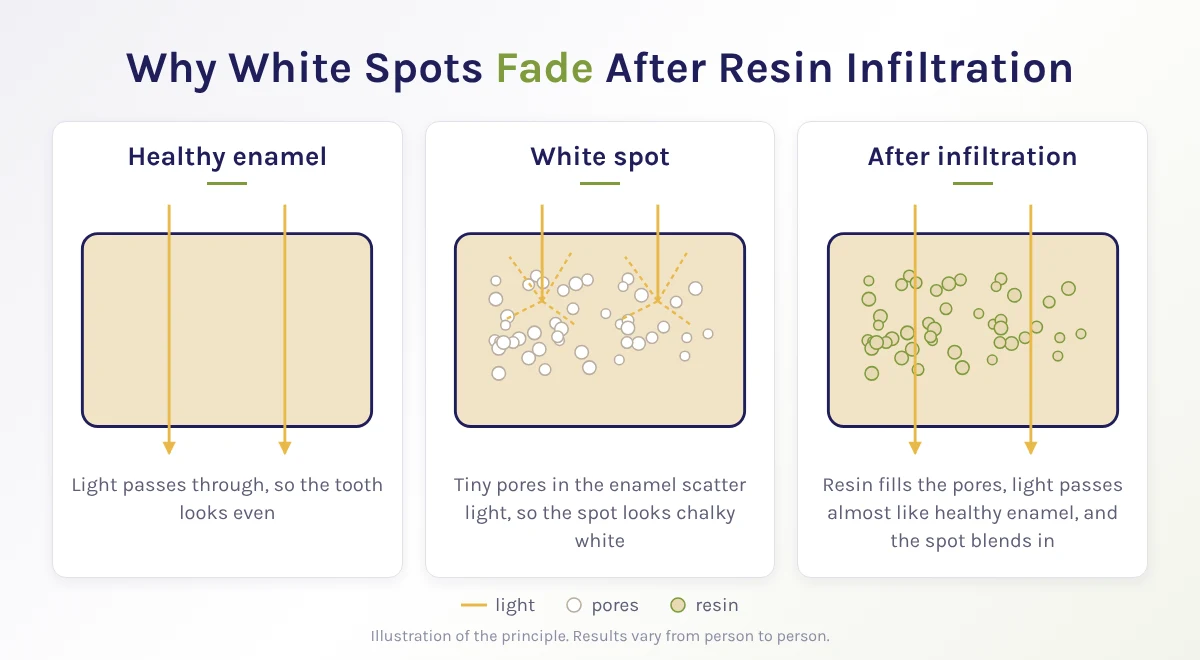
A white spot is not a stain on the surface. It is enamel that has lost minerals and has tiny pores inside, known in dentistry as a white spot lesion (WSL). The pores hold water or air, which bend light very differently from enamel, so light scatters and the spot looks chalky white. The resin bends light much more like enamel does. Once it replaces the water and air in the pores, light passes through almost as it does in healthy enamel, and the spot fades or blends in. This is also why polishing or whitening alone usually cannot remove this kind of white spot.
What causes white spots on teeth?
- White spots after braces form when plaque builds up around brackets for a long time and the enamel starts to lose minerals. This is the earliest stage of decay, and it often becomes obvious when the braces come off.
- Early decay that has not become a cavity looks like a chalky spot on the tooth surface.
- Dental fluorosis comes from taking in too much fluoride while the teeth are forming in childhood (see the next section).
- Enamel that did not form properly, such as MIH (molar incisor hypomineralisation), which shows as white, cream or yellow-brown patches on molars and front teeth, or a mark on an adult tooth after the baby tooth before it was injured or infected.
Can resin infiltration treat fluorosis?
Yes, when the fluorosis shows as mild to moderate white spots and the enamel is still smooth. A 2021 review of the research by Bourouni and colleagues lists resin infiltration as an option for this level of fluorosis. Severe fluorosis with dark brown marks or pitted enamel usually only fades with resin, and may need another option such as composite bonding or veneers.
Fluorosis comes from taking in too much fluoride while the teeth are forming in childhood, for example from drinking water that is naturally high in fluoride or from young children swallowing toothpaste. Normal brushing with fluoride toothpaste as an adult does not cause it.
Who is resin infiltration for?
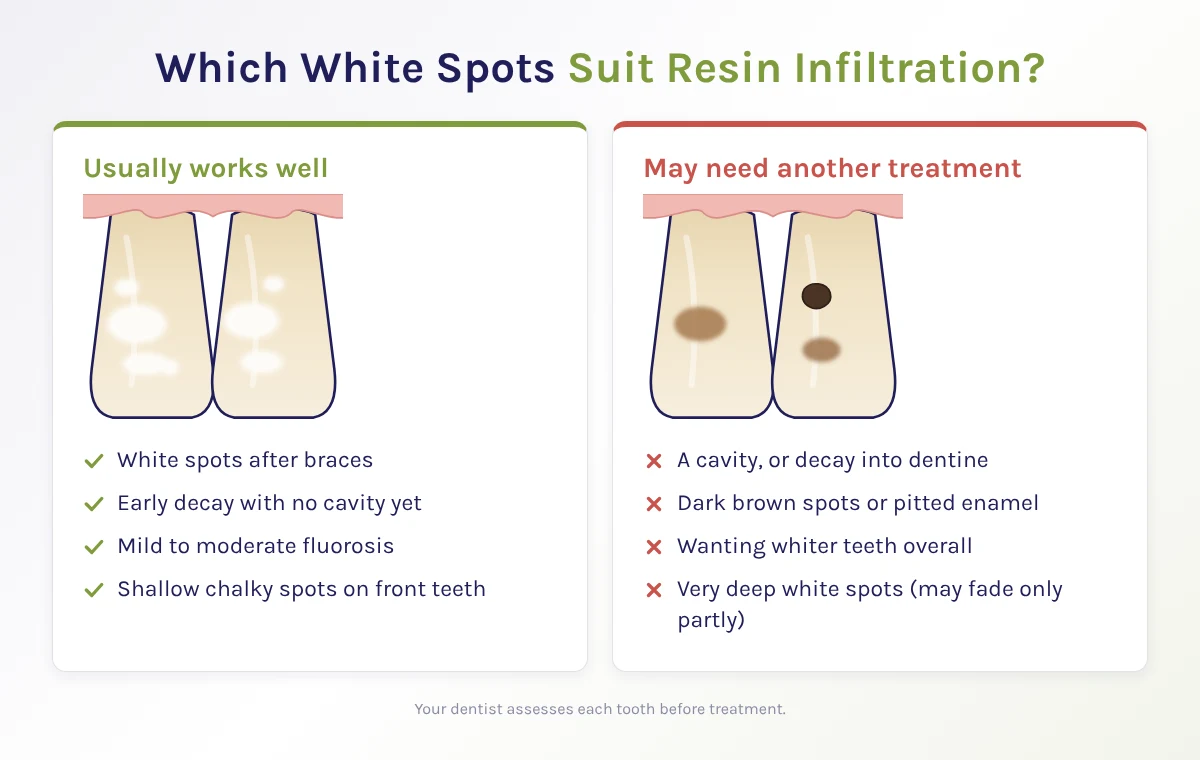
Usually works well for
- White spots after braces. A small study by Kim and colleagues (2011, 18 teeth) found these spots were fully masked in about 6 in 10 teeth and partly improved in about 3 in 10 more.
- Early decay with no cavity.
- Mild to moderate fluorosis with white spots and smooth enamel.
- People who want to treat individual white spots without drilling.
May need another treatment, or a combination
- A cavity, or decay that has reached the dentine, needs a filling instead.
- Severe fluorosis with dark brown marks or pitted enamel.
- MIH spots, where results are less predictable. A 2025 review of the research found full masking in about 1 in 3 cases, with most spots only fading (low-certainty evidence).
- Wanting whiter teeth overall. Resin infiltration does not change the colour of the whole tooth. It only helps the spot match the shade the tooth already has.
- If you have ever reacted to dental resin materials, tell your dentist first.
Your dentist checks each tooth before treatment.
Resin infiltration technique, step by step
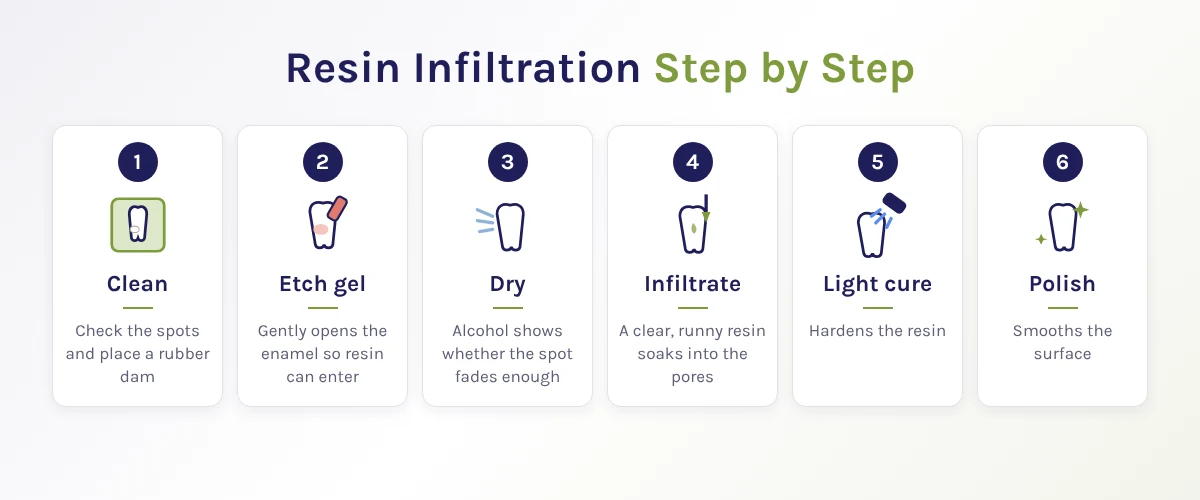
- Check and clean The dentist assesses the spots and places a rubber dam so the teeth stay completely dry and the gel does not touch the gums.
- Etch gel A special acid gel gently opens up the outer enamel so the resin can enter.
- Dry and preview An alcohol drying liquid is applied. If the spot fades at this point, it is likely to mask well. If it is still white, the dentist may repeat the gel.
- Infiltrate A clear, runny resin is left on the tooth to soak into the pores.
- Light cure A curing light hardens the resin, then a second layer of resin is applied and cured.
- Polish The surface is polished smooth, which helps reduce staining.
At Smile & Co. it takes about 30 minutes per tooth. Most people need no injection because no drilling is involved, and a rubber dam is placed during treatment. You may feel some pressure from the rubber dam or mild sensitivity while the gel is on. Several teeth can be treated in one visit.
Results: what to expect and how long it lasts
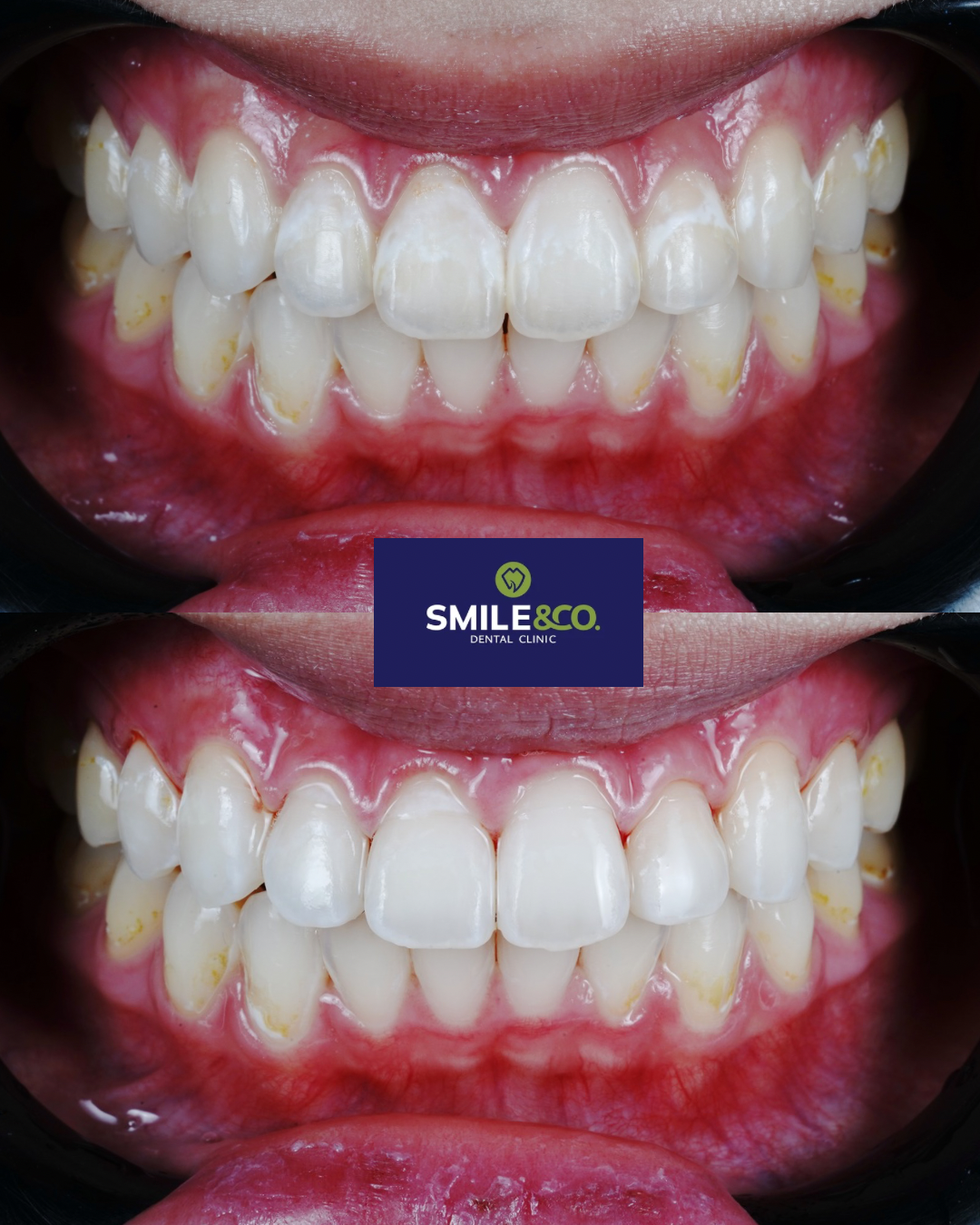
Real Smile & Co. Dental Clinic case, published with the patient’s consent. Results vary from person to person.
- Right after treatment: most spots fade on the day, and they may blend in a little more over the following days to 1–2 weeks. Some spots fade but do not disappear completely, especially deeper ones.
- Follow-up visit: some patients come back after about 2 weeks to check the result. There is no treatment charge, only the 50 THB sterilisation fee. If a spot is still obvious, the dentist may suggest repeating the treatment or another option, such as composite bonding, and will tell you the cost first.
- How long it lasts: a study following white spots after braces found the result stayed stable for about 3 years (Knösel and colleagues, 2019). It was a small study, and there is very little data beyond about 3–4 years.
- Slowing decay (research on decay between teeth, which uses a special kit for those surfaces): a Cochrane review (2015) found that micro-invasive treatments, including resin infiltration, cut the chance of decay progressing by about three quarters compared with hygiene advice and fluoride alone. A study followed for about 7 years found decay progressed in 9% of treated teeth versus 45% of teeth given usual care. So it slows decay, but it cannot guarantee that every lesion will not progress, and regular check-ups are still needed.
- Staining: polished resin does not stain much more easily than natural tooth, but it is worth having it checked and polished at your regular check-ups.
How soon after braces can I have it done?
In general it can be done once the gums have settled after the braces come off. You do not always need to wait several months. Some studies suggest treating earlier may work better (Knösel 2013, Wierichs 2023), probably because over time the outer layer of the spot can harden and make it harder for the resin to soak in. The evidence is not strong enough to set a fixed waiting time, so your dentist will advise case by case.
If you are still wearing braces, the key is to prevent white spots in the first place: brush carefully around the brackets, use fluoride toothpaste and keep your check-up appointments. Learn more about orthodontic treatment.
Can children have resin infiltration?
There is research in children and teenagers with permanent teeth, especially for MIH spots (Prado and colleagues, 2025), where results are less predictable than for white spots after braces. A child needs to sit still and accept a rubber dam for the whole treatment, so there is no fixed minimum age. It should be assessed by a dentist case by case.
Resin infiltration vs whitening, microabrasion and veneers
| Resin infiltration | Teeth whitening | Microabrasion | Veneers | |
|---|---|---|---|---|
| Best for | Individual white spots, early decay | Yellow or darker teeth overall | Shallow marks on the outermost surface | Changing the colour and shape of the whole tooth |
| Tooth structure removed? | No drilling, a gel opens the surface slightly | No | A thin layer is polished away with a mildly acidic paste | Ceramic veneers need a little enamel removed, composite veneers do not |
| Effect on white spots | Spots fade or blend in | Teeth get whiter, but white spots often remain visible | Shallow spots fade gradually | Usually covers the spots |
- Teeth whitening makes the whole tooth whiter, but white spots often stay visible. If you want both whiter teeth and less visible white spots, whitening first and waiting about 2 weeks before resin infiltration is generally recommended, following the manufacturer’s advice. Learn more about teeth whitening.
- Microabrasion polishes away the outermost layer of enamel with a mildly acidic abrasive paste. No drill is used, and it suits shallow marks. A study by Gu and colleagues (2019) found that at 12 months the remaining spot area was smaller after resin infiltration than after microabrasion (about 4% vs 11% of the tooth surface), although the overall colour difference was similar.
- Veneers suit deeper or more severe marks, or when you also want to change tooth shape and colour. Ceramic veneers need a little enamel removed. Learn more about veneers.
- A tooth with a cavity needs a filling instead.
Aftercare
- You can eat and drink normally after treatment. If you can, avoid tea, coffee and strongly coloured food on the day of treatment, because teeth that were under the rubber dam for a while are dry and pick up stains more easily for a short time.
- Brush with fluoride toothpaste and floss every day.
- If the gum around the tooth feels irritated or shows a small white mark from the gel, it usually settles within a few days. If you have unusual pain or sensitivity, or the gum is not better in 2–3 days, contact the clinic.
- Keep your check-up and polishing appointments so the dentist can check the treated spots and look for any new decay.
How much does resin infiltration cost?
| Treatment | Price |
|---|---|
| Resin infiltration (Icon) | 4,000 THB per tooth |
| 4 or more teeth on the same day | 3,500 THB per tooth |
Example: 4 teeth on the same day cost 4 × 3,500 = 14,000 THB.
Not included
- Instrument sterilisation fee, 50 THB per visit
- X-rays, if the dentist needs one, charged as on our price list (white spots on front teeth usually do not need an X-ray)
- Any other treatment you may need, such as scaling or fillings, charged as on our price list
The follow-up visit has no treatment charge, only the usual 50 THB sterilisation fee.
The dentist will examine you and confirm how many teeth are suitable and the full cost before treatment starts.
Resin infiltration at Smile & Co. Dental Clinic
- We use Icon (DMG, Germany).
- A rubber dam keeps the teeth dry, helps the resin soak in and keeps the gel off your gums.
- About 30 minutes per tooth, and several teeth can be treated in one visit.
- Open every day, on the 3rd floor of Wannasorn Tower, near BTS Phaya Thai Exit 4.
Resin infiltration FAQ
At Smile & Co. it costs 4,000 THB per tooth, or 3,500 THB per tooth when 4 or more teeth are treated on the same day (for example, 4 teeth = 14,000 THB). A 50 THB sterilisation fee per visit, X-rays if needed and any other treatment are charged separately.
Most people do not need an injection, because no drilling is involved. You may feel some pressure from the rubber dam or mild sensitivity while the gel is on.
A study following white spots after braces found the masking stayed stable for about 3 years. There is little data beyond that, so there is no evidence yet that it is permanent, so keep up regular check-ups and polishing.
Most fade, but not every spot disappears. White spots after braces usually respond well. Deep spots, MIH spots or brown marks may only fade. Your dentist will assess them before treatment.
Yes. The manufacturer suggests checking the result after about 2 weeks. If a spot is still visible, the treatment may be repeated, or another option such as composite bonding may be suggested. The dentist will assess it and tell you the cost first.
Some shallow spots fade a little with good cleaning, but research shows most untreated spots barely change. If a spot is still obvious, talk to a dentist once your gums have settled.
Mild to moderate white fluorosis can be made less visible with resin infiltration. Dark brown marks or pitted enamel may need another option, such as composite bonding or veneers.
The manufacturer recommends whitening first, then waiting about 2 weeks before resin infiltration, so the treated spots match your new shade. If you have already had resin infiltration and want to whiten later, there is little data, so ask your dentist first.
Polished resin does not stain much more easily than natural tooth. If you can, avoid tea, coffee and strongly coloured food on the day of treatment, and have the teeth polished at your check-ups.
Resin infiltration needs no drilling and treats individual white spots. Veneers cover the whole front of the tooth and can change its colour and shape. Ceramic veneers need a little enamel removed, so they suit deeper or more severe problems.
Smile & Co. Dental Clinic is on the 3rd floor of Wannasorn Tower, near BTS Phaya Thai Exit 4, and is open every day. We use Icon (DMG) with a rubber dam, and treatment takes about 30 minutes per tooth.
References
- Kim S, et al. Int J Paediatr Dent. 2011;21:241–248. doi:10.1111/j.1365-263X.2011.01126.x
- Knösel M, Eckstein A, Helms HJ. Am J Orthod Dentofacial Orthop. 2013;144:86–96. doi:10.1016/j.ajodo.2013.02.029
- Knösel M, Eckstein A, Helms HJ. Angle Orthod. 2019;89:33–39. doi:10.2319/052118-383.1
- Gu X, et al. Angle Orthod. 2019;89:372–377. doi:10.2319/041218-274.1
- Bourouni S, et al. Clin Oral Investig. 2021;25:4711–4719. doi:10.1007/s00784-021-03931-7
- Dorri M, et al. Cochrane Database Syst Rev. 2015;CD010431. doi:10.1002/14651858.CD010431.pub2
- Paris S, et al. J Dent. 2020;93:103277. doi:10.1016/j.jdent.2020.103277
- Prado NA, et al. J Dent. 2025;155:105617. doi:10.1016/j.jdent.2025.105617
- Wierichs RJ, et al. J Dent. 2023. doi:10.1016/j.jdent.2023.104713